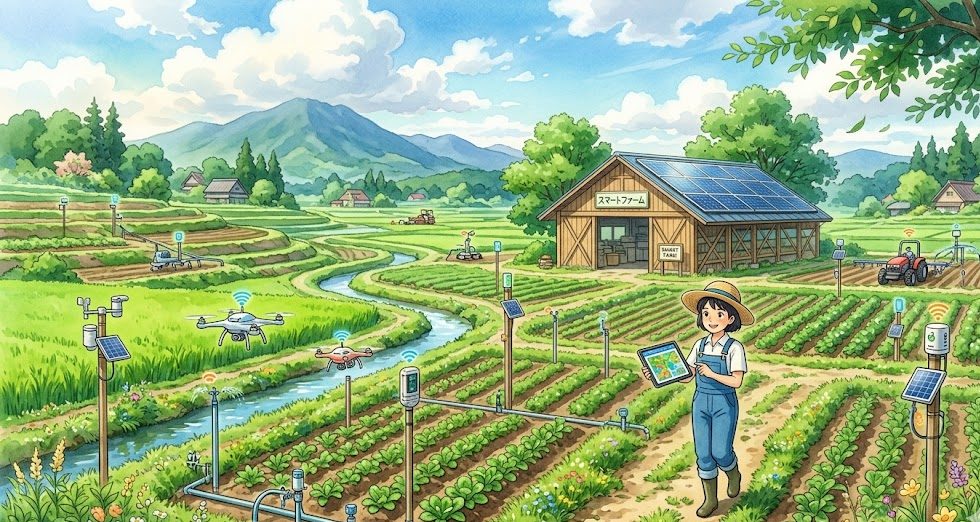
The agricultural sector is undergoing a massive digital overhaul. For centuries, farming relied heavily on ancestral intuition, seasonal guesswork, and manual labor. However, with the onset of rapid climate change, depleting fresh water resources, and an exploding global population, traditional methods are no longer sufficient to maintain profitable yields.
The integration of Smart Farming Technologies, IoT Automation, and Precision Agriculture is turning traditional fields into highly optimized, data-driven production centers.
By utilizing connected sensors, real-time analytics, and automated machinery, modern farmers are drastically reducing input costs (like water, fertilizers, and pesticides) while exponentially increasing crop quality and yield. In this complete guide, we will analyze the core pillars of smart agriculture, the tech driving this change, and how to successfully implement automation for maximum ROI.
1. What is Precision Agriculture?
Precision Agriculture (PA) is a farm management concept based on observing, measuring, and responding to inter-field and intra-field variability in crops. Instead of treating an entire 50-acre farm uniformly, precision farming allows growers to manage their land on a square-meter or even individual-plant basis.
The core philosophy of precision agriculture centers around five key variables:
- Right Place: Applying resources exactly where they are needed.
- Right Time: Executing farm inputs at the optimal physiological moment.
- Right Product: Selecting precise nutrient or chemical formulations.
- Right Quantity: Dosing inputs down to the exact milliliter or gram.
- Right Method: Implementing the most efficient application path.
By substituting data for physical materials, precision agriculture eliminates over-fertilization, saves localized water networks, and protects adjacent soils from chemical runoff.
2. The Power of IoT Automation in Agriculture
The Internet of Things (IoT) serves as the physical backbone of smart farming. An agricultural IoT network consists of specialized sensors deployed across fields, connected to actuators (like motorized valves and pumps) via wireless protocols (such as LoRaWAN, Wi-Fi, or cellular networks). This creates a continuous, automated feedback loop.
Key Applications of Agri-IoT:
- Automated Smart Irrigation: Soil moisture sensors placed at different root depths measure the volumetric water content in real-time. When moisture drops below a predefined threshold, a signal is sent to the cloud, which automatically triggers a motorized drip valve to water the crops. Once optimal hydration is reached, the system shuts down, preventing water wastage.
- Microclimate Monitoring: On-farm weather stations track localized relative humidity, ambient temperature, wind speed, and solar radiation. This allows predictive software to alert farmers about frost warnings or high-evaporation periods before they impact crops.
- Livestock Tracking and Health Biometrics: Smart collars equipped with GPS and biometric sensors track animal movement, body temperature, and rumination activity. This allows large-scale dairy or cattle farmers to isolate sick animals days before physical symptoms show up.
3. Core Technologies Driving Smart Farming
To build a fully integrated smart farming eco-system, multiple next-generation technologies must operate simultaneously:
A. Satellite Remote Sensing & GIS
Geographic Information Systems (GIS) and high-resolution satellite imagery allow farmers to view their lands from orbit. By analyzing the Normalized Difference Vegetation Index (NDVI), software can map out precisely which zones of a field have healthy chlorophyll levels and which patches are suffering from nutrient stress or underwatering.
B. Variable Rate Technology (VRT)
Traditional tractors spray fertilizer uniformly across fields, wasting money on areas that don’t need it. Tractors equipped with Variable Rate Technology read automated digital soil maps while moving. As the tractor drives across different zones, the onboard computer dynamically changes the spray output nozzle flow, dropping more fertilizer on nutrient-deficient zones and less on rich areas.
C. AI and Machine Learning Diagnostics
Artificial Intelligence acts as the analytical brain of smart farming technology. Machine learning algorithms process millions of historical data points—such as soil quality data, weather trends, and pest life cycles—to provide predictive insights, ensuring farmers know exactly when to plant, harvest, and spray.
Smart Farming vs. Traditional Farming: A Comparative Framework
To evaluate the exact financial and resource impacts of adopting smart automation tech, review the operational matrix below:
| Operational Parameter | Traditional Farming | Smart Farming (IoT & Precision Agri) | System Impact / ROI |
|---|---|---|---|
| Water Management | Flood irrigation based on fixed weekly schedules. | Soil sensor-driven automated micro-drip lines. | Up to 45% reduction in total water usage. |
| Pest Control | Proactive, blanket chemical spraying across the whole farm. | Targeted drone/spot spraying based on early AI detection. | 60% reduction in chemical costs; cleaner produce. |
| Labor Dependency | High manual labor required for checking fields and crops. | Remote dashboard monitoring via smartphone or PC. | Lower overhead expenses and higher operational speed. |
| Yield Predictability | Highly volatile; dependent on weather luck. | Consistent; protected by predictive data modeling. | Stable, predictable supply chains for contract buyers. |
Export to Sheets
4. Key Implementation Strategies for Smart Cultivation
Transitioning your agricultural venture into an automated setup requires a step-by-step approach to avoid wasting capital on unnecessary hardware.
Step 1: Establish Field Connectivity
Before purchasing expensive sensors, ensure your farm has an operational data network. Because fields cover large distances, standard Wi-Fi is rarely sufficient. Implementing a LoRaWAN (Long Range Wide Area Network) gateway allows you to connect thousands of battery-powered sensors up to 10–15 kilometers away with minimal power drain.
Step 2: Begin with Variable Rate Fertigation
The fastest way to see an immediate return on investment is by automating your nutrient mixing unit (fertigation). Connect a digital EC/pH sensor block to your main irrigation line. This ensures your crops receive perfectly balanced nutrient inputs automatically, boosting initial crop quality within a single harvest cycle.
Step 3: Utilize Drone Scouting Services
If purchasing high-end autonomous drones is outside your initial budget, tap into localized “Drone-as-a-Service” (DaaS) providers. Having your fields scanned once a month provides critical multispectral maps that pinpoint early fungal outbreaks and weed concentrations, saving you from expensive full-field crop losses.
Overcoming Key Challenges in Smart Agri Adoption
Critical Operational Note for Investors: The single largest bottleneck in precision agriculture is data fragmentation. Often, a farmer will buy soil sensors from one company, a smart tractor from another, and drone mapping software from a third party—only to find out the platforms cannot talk to each other. Always prioritize hardware and software ecosystems that support open APIs and standard data formatting to ensure all your machinery integrates seamlessly.
Furthermore, deploying rugged electronics into harsh agricultural environments means components must have an IP67 or IP68 weather-proof rating to withstand extreme heat waves, mud, heavy monsoons, and pest chewing.
Conclusion: The Automated Horizon of Global Agriculture
Integrating Smart Farming Technologies, deploying IoT Automation, and practicing Precision Agriculture is no longer a futuristic hobby for tech enthusiasts; it is an economic necessity. As agricultural inputs become more expensive and profit margins shrink, data-driven automation provides the exact competitive advantage needed to remain profitable.
By shifting your farm from guesswork to precision, you minimize input waste, protect regional soil health, and secure high-volume, premium-tier crop harvests season after season.
FAQ: Frequently Asked Questions
Q1. What is the difference between Smart Farming and Precision Agriculture? Precision Agriculture focuses on the specific accuracy of inputs (treating different zones uniquely based on field data), while Smart Farming is a broader term that encompasses the use of connectivity, IoT automation, cloud dashboards, and data tracking to optimize the overall farm business.
Q2. Do smart farming technologies work on small farms? Yes. While heavy machinery like autonomous tractors require large acreage to be financially viable, plug-and-play IoT devices like smartphone-controlled irrigation valves, low-cost soil sensors, and mobile crop diagnostic apps are highly affordable and effective for small-scale farms.
Q3. How do IoT sensors get power in deep rural fields? Most modern agricultural IoT sensors operate on ultra-low power configurations, running on internal batteries that can last 3 to 5 years without replacement. Many units also feature small, integrated solar panels to continuously recharge their internal cells.