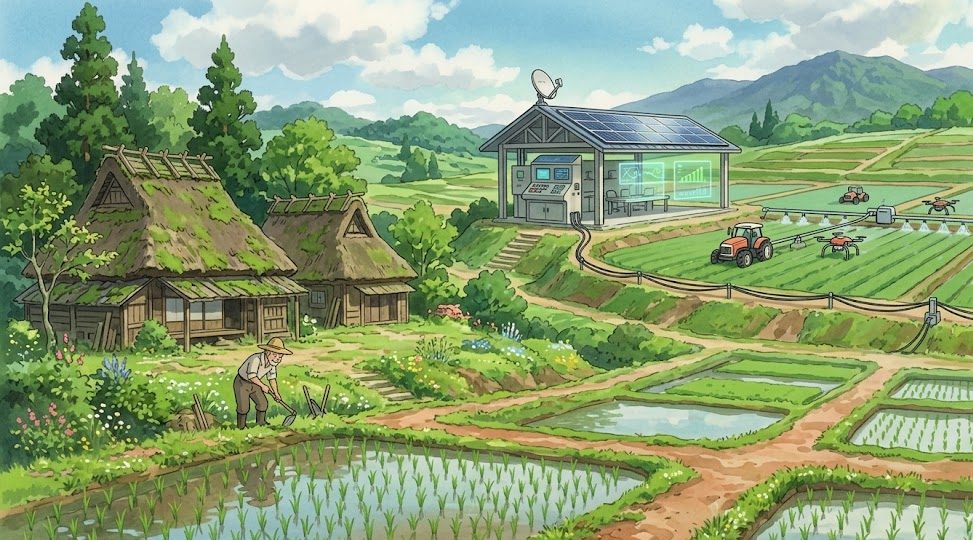
For generations, farming was an art form passed down through lineage. It was a practice rooted in observation, intuition, and ancestral wisdom—”knowing” when to sow based on the color of the sky or the behavior of the wind. While this traditional knowledge remains the bedrock of agriculture, the 21st century has introduced a new, indispensable partner: Data.
The shift from traditional to “Smart Agriculture” (often called Precision Farming) is not about abandoning the old ways. It is about augmenting them with scientific precision. By leveraging real-time data, farmers are transitioning from making decisions based on broad generalizations to making decisions based on the specific, granular needs of their fields.
The Data Revolution: What Changed?
In the past, a farmer managed their land as a single, uniform unit. They applied the same amount of water and fertilizer across the entire field because they lacked the means to differentiate. Today, technology—ranging from satellite imagery to ground-level IoT sensors—allows the farmer to see their land in “High Definition.”
When you can measure it, you can manage it. Data-driven decision-making turns the farm into a controlled production facility where every input is optimized for the best possible output.
Key Data Pillars of Smart Agriculture
1. Soil Health and Nutrient Mapping
Soil is the most complex biological system on the planet. Traditional farming often relied on blanket application of fertilizers, leading to wasted input costs and soil degradation.
- The Smart Shift: Using GPS-guided soil sampling, farmers create “Nutrient Maps” of their fields. These maps pinpoint exactly which zones are low in nitrogen, phosphorus, or potassium.
- The Result: Variable Rate Technology (VRT) allows tractors to apply fertilizer only where it is needed, reducing fertilizer use by 15–30% while simultaneously increasing crop uniformity.
2. The Power of “Eye in the Sky” (Satellite & Drone Imagery)
Gone are the days when you had to walk every row to assess crop health.
- The Smart Shift: Satellite data and drone-mounted multispectral cameras can detect plant stress (from pests, diseases, or drought) long before it is visible to the human eye. These tools calculate the Normalized Difference Vegetation Index (NDVI), a numerical indicator of plant vigor.
- The Result: A farmer can pinpoint a small patch of disease in a massive field and apply treatment only to that spot, preventing a localized problem from becoming a field-wide catastrophe.
3. Hyper-Local Weather Analytics
Weather is the single biggest variable in farming. While national forecasts provide a “big picture,” they are often inaccurate for a specific farm that might be miles away from a weather station.
- The Smart Shift: Low-cost, on-farm weather stations provide hyper-local data on rainfall, humidity, wind speed, and temperature.
- The Result: This data helps in making precise decisions about spraying. If the wind speed is too high, the system alerts the farmer to hold off on pesticide application to avoid drift, saving money and protecting the environment.
4. Irrigation Management
Water is often the most expensive input. Over-irrigation kills roots and wastes energy, while under-irrigation stunts growth.
- The Smart Shift: IoT moisture sensors buried at various root depths stream data to the farmer’s smartphone.
- The Result: The system calculates the exact evapotranspiration (ET) rate and informs the farmer exactly how many liters of water are needed to reach field capacity. It removes the guesswork and moves farming into the realm of mathematical precision.
The Business Impact: Efficiency as Profit
The economic argument for data-driven farming is overwhelming:
- Lowering Input Costs: Fertilizer, pesticide, and water are expensive. By targeting these inputs, you reduce your “Cost of Goods Sold” (COGS) without sacrificing yield.
- Risk Mitigation: Data provides an early warning system. By identifying risks (pest outbreaks or nutrient deficiencies) early, you can act before the economic damage occurs.
- Access to Premium Markets: In 2026, many high-end supply chains require “traceability.” If you have data logs showing exactly how much water, fertilizer, and pesticide was used, you can command a premium price for “sustainably grown” produce.
Overcoming the “Digital Divide”
Critics often argue that “Smart Agriculture” is only for massive corporate farms. This is a misconception. Today, even small-scale farmers in India are using mobile-based apps to access real-time market prices, weather updates, and expert advice.
The barrier to entry isn’t necessarily money; it’s the learning curve. The transition requires a change in mindset:
- Start with Digitization: Simply recording your activities—when you planted, what you applied, and what the weather was like—is the first step toward building your own dataset.
- Focus on One Variable: You don’t need a million-dollar system. Start by installing one soil moisture sensor or using a free satellite imagery app. Master that one stream of data, and you will immediately see the value.
- Use Available Networks: Join farmer cooperatives or local groups that share data. There is strength in numbers; shared data about local pest patterns or market demand is often as valuable as individual field data.
The Future: The Farm as an Ecosystem of Information
As we look toward the future, the “Smart Farm” will evolve into a self-optimizing system. Artificial intelligence will eventually process these data streams to provide “prescriptive analytics”—the system won’t just tell you the soil is dry; it will automatically trigger the irrigation pumps to the exact level needed.
The transition from traditional to smart agriculture is not about replacing the farmer with a robot; it is about empowering the farmer with the information they need to be more successful. It is about taking the “luck” out of farming and replacing it with reliable, repeatable, and scientific decision-making.
By embracing data, you aren’t changing who you are as a farmer—you are becoming a more efficient, profitable, and resilient version of yourself. The data is already there, flowing through your fields; the only question is whether you are ready to listen to what it has to say.