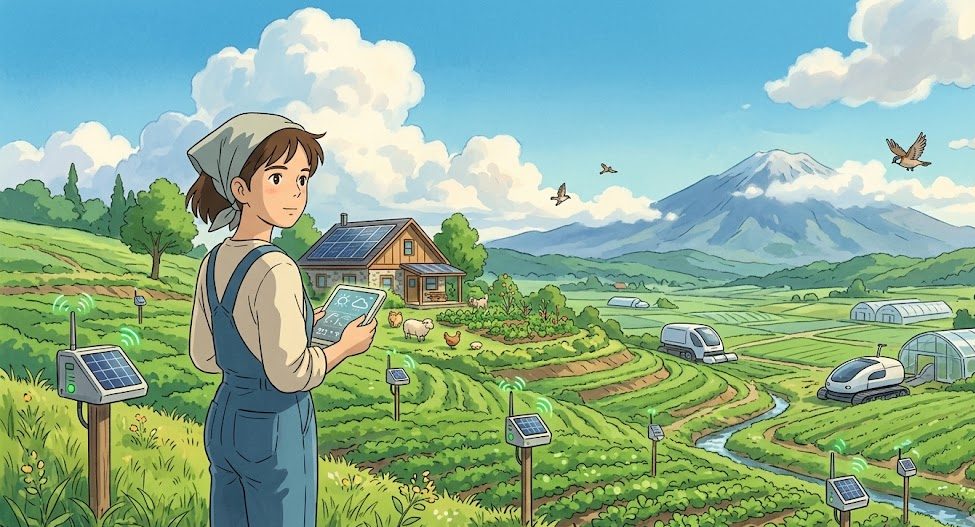
The unpredictability of weather has been the farmer’s greatest adversary since the dawn of agriculture. For centuries, success relied on tradition, intuition, and observation. But as we move deeper into 2026, the landscape of farming is shifting from “reactive” to “predictive.”
With the proliferation of the Internet of Things (IoT) and hyper-local data analytics, small-scale farmers now have the power to anticipate weather impacts before they occur. Smart farming isn’t about replacing the farmer’s wisdom; it’s about augmenting it with precision, allowing you to turn weather patterns from a gamble into a manageable business variable.
The Anatomy of an IoT-Driven Farm
To manage what you cannot see, you must be able to measure it. In 2026, a “Smart Farm” is built on a network of low-cost, interconnected devices that feed data back to your smartphone in real-time.
- Soil Moisture Sensors: These buried probes tell you exactly how much water is at the root zone. When linked to weather forecasts, they can predict if you need to irrigate today or if an incoming storm will provide all the moisture your crops need.
- Micro-Climate Weather Stations: A national weather report for your district is often inaccurate for your specific plot. A local weather station installed on your farm captures precise humidity, wind speed, solar radiation, and rainfall data specific to your field.
- Leaf Wetness Sensors: This is the “killer app” for disease prevention. By monitoring the moisture on the surface of your leaves, sensors can alert you to the exact window when fungal pathogens are likely to germinate, allowing you to intervene only when necessary.
Data as a Predictive Tool: Moving Beyond the Forecast
Data is only valuable if it leads to better decisions. How do these tools change the daily life of a farmer?
1. Precision Irrigation: The End of “Guesswork”
In traditional farming, you water on a schedule. In 2026, you water based on demand. By integrating your soil moisture data with a 48-hour weather forecast, your system can “decide” whether to delay irrigation because a 60% chance of rain is expected. This isn’t just about saving water; it’s about preventing root rot and ensuring the plant has the ideal hydration level at all times.
2. Proactive Pest and Disease Management
Fungi and pests follow specific environmental triggers. For example, many fungal blights require high humidity combined with a specific temperature range to thrive. IoT sensors track these conditions. When your sensors detect that the “danger zone” has been reached, you receive a notification on your phone: “High risk of late blight in Sector B. Preventative application advised.” This allows you to protect your crops before the first symptom appears, reducing your chemical usage by up to 30%.
3. Optimizing Harvest Windows
Weather can make or break the quality of your produce. Rain during a harvest window can destroy grain quality or lead to rot in delicate fruits. By tracking hyper-local weather patterns, you can time your harvests for the “dry window”—the period of lowest humidity—ensuring your produce stays fresher for longer during storage and transport.
Overcoming the “High-Tech” Barrier
There is a common misconception that smart farming is only for industrial giants. In reality, the 2026 technology stack is surprisingly affordable.
- The Low-Cost Startup: You don’t need to wire your whole farm at once. Start with one soil moisture sensor and a mobile weather app that allows you to log your own field notes. Building a historical data set for your specific land is the first step toward “predicting” the future.
- Edge Computing: Modern devices are designed to work without needing expensive, high-speed fiber internet. Many operate on low-power, long-range networks (like LoRaWAN), which are perfect for rural settings with spotty connectivity.
- The “Shared Wisdom” Network: In 2026, regional farming cooperatives are beginning to share their sensor data. When you join a network, you aren’t just relying on your own data—you’re benefiting from the cumulative observations of every farmer in your region. This makes your local predictive models significantly more accurate.
From Intuition to Evidence
The shift toward smart farming is essentially a shift toward evidence-based decision-making. Think of it as having a second set of eyes on your fields 24/7. When you combine your years of experience with real-time data, you become a “Super-Farmer.” You know exactly when the frost is coming, you know exactly when the nutrient levels in your soil have dipped, and you know exactly how the current humidity is affecting your disease risk.
This level of control changes the economics of your farm:
- Higher Yields: Fewer crops lost to rot, drought, or pests.
- Lower Costs: Less water, less electricity, and less fertilizer wasted on runoff.
- Better Market Positioning: Produce that is monitored and documented for quality can be sold as “premium, sustainably managed” goods.
The Path Forward: Preparing for 2027 and Beyond
Smart farming is a journey of continuous improvement. The goal isn’t to create a system that runs itself; it’s to create a system that tells you where to focus your energy.
When you get an alert from your farm, you aren’t just responding to a notification—you are engaging in a dialogue with your land. You are treating the weather not as a force that happens to you, but as a pattern you can work with.
In 2026, the farmers who thrive will be those who embrace this data. The future of agriculture is clear: it’s greener, it’s more efficient, and it’s being built one sensor at a time.