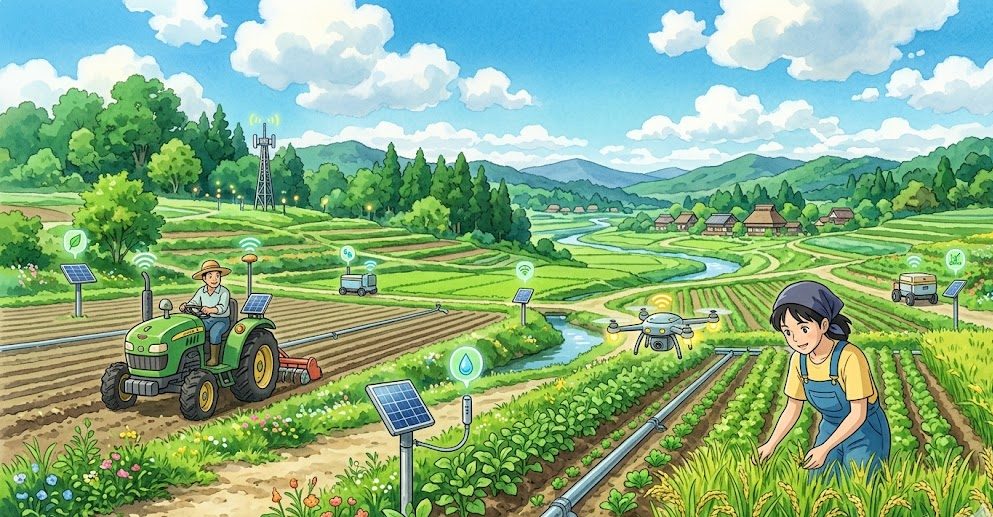
The agricultural sector, once defined by manual labor and ancestral intuition, is currently undergoing its most significant transformation since the Industrial Revolution. As the global population heads toward a projected 9.7 billion by 2050, the pressure on food systems is immense. We are no longer just “farming”; we are engaging in a high-tech race to maximize yield while minimizing environmental footprints. This transition, known as Smart Farming or Agriculture 4.0, leverages the Internet of Things (IoT), Big Data, and Artificial Intelligence (AI) to turn the field into a data-driven factory.
1. The Core Pillars of Smart Farming
At its heart, smart farming is about precision. Instead of treating an entire 100-acre field as a single unit, technology allows farmers to treat each square meter—or even each individual plant—differently. This is achieved through three primary technological layers:
- Sensor Networks (The Nervous System): Soil moisture sensors, weather stations, and leaf-color scanners provide real-time data. They tell the system exactly when a plant is “thirsty” or lacking specific nutrients.
- Connectivity and Big Data (The Brain): All this data is transmitted via 5G or satellite links to cloud platforms. Here, machine learning algorithms analyze historical weather patterns and current soil conditions to predict future needs.
- Automation and Robotics (The Muscle): This is where the “automated crop management” comes in. Once the brain decides what needs to be done, autonomous machinery executes the task without human intervention.
2. Automated Irrigation: Every Drop Counts
Water scarcity is one of the greatest challenges of the 21st century. Traditional “flood” or “sprinkler” irrigation often results in significant waste due to evaporation and runoff.
Smart Irrigation Systems use soil moisture probes and evapotranspiration data to automate water delivery. If the sensors detect that the root zone is sufficiently hydrated, the system automatically shuts off the valves. Conversely, if a heatwave is detected via a weather API, the system can preemptively hydrate the soil.
Key Benefit: Studies show that automated precision irrigation can reduce water usage by up to 30-50% while simultaneously increasing crop health by preventing over-saturation and root rot.
3. AI-Driven Pest and Disease Management
Historically, farmers practiced “blanket spraying”—applying pesticides across an entire field regardless of where the pests were located. This is expensive and environmentally damaging.
The digital revolution has introduced Computer Vision. Drones equipped with multispectral cameras fly over crops to identify early signs of stress, fungus, or insect infestations that are invisible to the human eye.
- Automated Spot Spraying: Modern tractors equipped with AI cameras can identify a weed in a fraction of a second and spray a micro-dose of herbicide only on that specific weed, leaving the crop untouched.
- Pheromone Traps: IoT-connected traps can count the number of pests caught and automatically alert the farmer when a threshold is reached, triggering a localized response.
4. The Rise of the Farm Bots: Planting and Harvesting
The most visible sign of the revolution is the disappearance of the driver from the tractor. Autonomous Tractors and Robotic Harvesters are solving the global labor shortage in agriculture.
- Autonomous Seeding: Robots like the Carbon Robotics or John Deere’s autonomous 8R use GPS and LiDAR to plant seeds with millimeter precision. This ensures optimal spacing, which reduces competition for nutrients.
- Robotic Harvesting: Picking delicate fruits like strawberries or grapes has always required a human touch. However, new soft-robotics grippers combined with AI can now identify ripeness and harvest produce without bruising it, working 24/7 without fatigue.
5. Data Analytics and Yield Prediction
In the digital age, Data is the new Fertilizer. By collecting data year-over-year, smart farming platforms create “Yield Maps.” These maps help farmers understand why one corner of a field produces more than another.
By applying Variable Rate Technology (VRT), automated machinery can adjust the flow of seeds or fertilizers on the fly based on these maps. If the soil is naturally rich in nitrogen in a certain area, the machine automatically applies less, saving money and preventing nitrogen runoff into local water sources.
6. Challenges to Adoption
Despite the glowing benefits, the “Digital Revolution” faces significant hurdles:
- High Initial Cost: The capital required for drones, sensors, and autonomous machinery is a barrier for small-scale farmers.
- Technical Literacy: Farming now requires skills in data analysis and hardware maintenance, not just agronomy.
- Connectivity Issues: Many rural areas still lack the high-speed internet (5G) required to transmit massive datasets from sensors to the cloud.
- Data Privacy: As farm data becomes valuable, questions arise about who owns the data—the farmer or the tech company that built the tractor?
7. The Environmental Imperative
Beyond profits, smart farming is a necessity for the planet. By automating crop management, we move toward Regenerative Agriculture. Precise application of chemicals reduces the “dead zones” in our oceans caused by fertilizer runoff. Furthermore, autonomous electric tractors can significantly reduce the carbon footprint of food production compared to traditional diesel-guzzling machinery.
Conclusion
The Digital Revolution in agriculture is not just about “fancy gadgets”; it is a fundamental shift in how we interact with nature. By integrating Smart Farming Technologies, we move away from the “guesswork” of the past and toward a future of “calculated abundance.”
As these technologies become more affordable and interconnected, the dream of a fully automated, self-sustaining farm becomes a reality. This revolution ensures that we can feed the world’s growing population without destroying the very earth that sustains us. The future of farming is green, it is digital, and above all, it is smart.