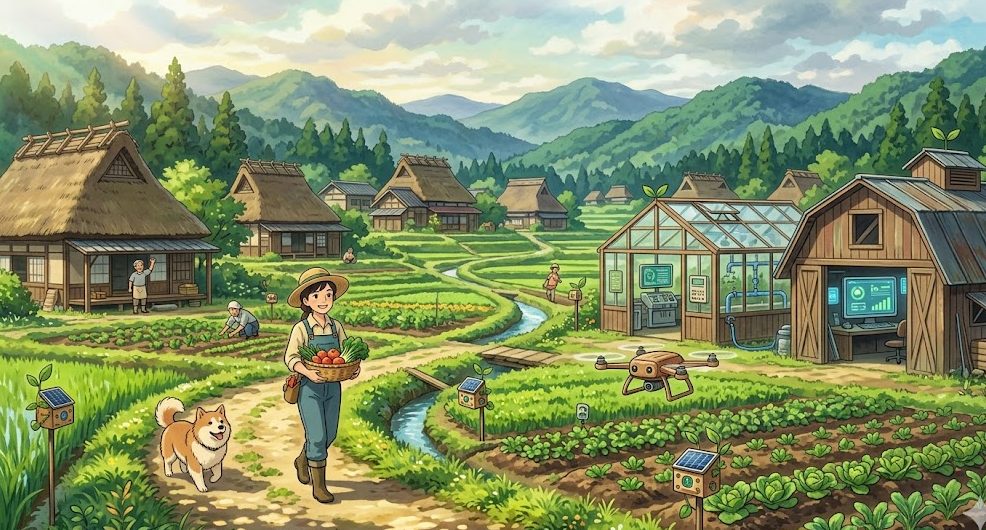
The traditional concept of farming has long been associated with vast expanses of land managed by seasonal intuition, manual labor, and historical weather calendars. While these methods sustained humanity for centuries, modern agriculture is facing unprecedented pressures. Rapidly depleting water tables, erratic climate shifts, soaring input costs, and a shrinking agricultural workforce mean that farmers can no longer afford to treat an entire field as a single, uniform entity.
The solution lies in shifting our focus from the size of the farm to the depth of the data. Welcome to The Tech-Driven Acre—an ecosystem where field management transitions from broad guesswork to a square-meter scale. By leveraging the Internet of Things (IoT), artificial intelligence, and cloud telemetry, smart farming allows modern growers to maximize crop yields, cut waste, and turn unpredictable acres into highly optimized, predictable production zones.
1. What is an IoT-Driven Smart Farm?
At its core, the Internet of Things (IoT) in agriculture refers to a network of physical objects—sensors, automated valves, weather stations, and drone systems—embedded with software and connectivity. These devices continuously collect data points directly from the field and transmit them over wireless networks (such as LoRaWAN, Wi-Fi, or cellular) to a centralized cloud dashboard accessible on a smartphone or computer.
Instead of physically walking the fields to check soil moisture or inspect for pests, a smart grower relies on continuous telemetry. This data stream allows for Variable-Rate Application (VRA), meaning inputs like water, nitrogen, and crop protection are delivered precisely when and where they are needed, rather than being blanketed across the entire farm.
2. Core Components of the Tech-Driven Acre
To build a high-yielding smart acre, several layers of modern hardware and software must work together seamlessly:
Sub-Surface Soil Telemetry
The foundation of precision yield optimization sits beneath the ground. Multi-depth IoT soil probes are placed throughout different soil zones to measure three critical parameters:
- Volumetric Water Content (VWC): Tracks exactly how much moisture is available around the root zone, preventing both under-watering and root-suffocating over-watering.
- Electrical Conductivity (EC): Measures soil salinity levels, telling farmers exactly how many nutrients are present in the soil and when fertilizer reserves are running low.
- Soil Temperature: Helps determine the perfect micro-window for planting seeds, maximizing germination success rates.
Edge-Computing Weather Stations
Generic regional weather forecasts are often inaccurate for hyper-local microclimates. Micro-weather stations installed directly on the farm track wind speed, ambient temperature, relative humidity, and solar radiation. Combined with predictive AI, these stations can warn a farmer of incoming frost, heatwaves, or high-humidity windows that are highly likely to trigger fungal outbreaks.
Automated Fertigation and Drip Systems
When soil sensors detect moisture levels dropping below a specific structural threshold, they communicate directly with cloud-connected smart valves. The system automatically triggers Smart Drip Fertigation, pumping a perfectly calculated mix of water and liquid nutrients right to the plant roots, turning off automatically the moment the root zone hits saturation.
+-----------------------------------------------------------------------+
|                    THE TECH-DRIVEN ACRE ARCHITECTURE                  |
+-----------------------------------------------------------------------+
|                                                                       |
|   [ FIELD INPUTS ]   ---> IoT Soil Probes & Micro-Weather Stations    |
|                                                                       |
|   [ EDGE TO CLOUD ]  ---> Wireless LoRaWAN Gateway Gateway             |
|                                                                       |
|   [ SMART ACTION ]   ---> Automated Drip Valves & Drone Sprayers      |
|                               (Precision watering & target inputs)    |
|                                                                       |
+-----------------------------------------------------------------------+
3. Crop Protection via AI and Drone Integration
Optimizing an acre isn’t just about feeding crops; it’s about defending them with precision. Modern smart farming replaces standard chemical spraying routines with targeted, automated interventions.
Multispectral Drone Mapping
Equipped with specialized cameras, agricultural drones fly pre-programmed autonomous paths over the farm. These cameras capture light wavelengths that are invisible to the human eye, measuring the Normalized Difference Vegetation Index (NDVI). An NDVI map highlights exact patches of a field showing early signs of chlorophyll degradation or stress, allowing farmers to address pest hotspots days before an infestation spreads across the entire crop.
Pheromone IoT Traps
Next-generation pest management includes automated pheromone traps equipped with micro-cameras and AI image recognition. When target pests enter the trap, the internal camera snaps a picture, and the cloud software identifies the insect species. If the population hits an economic threshold, the farmer receives an automated alert to deploy localized, organic biopesticides immediately.
Operational Comparison: Conventional vs. Smart Acreage
Transitioning away from legacy farming structures to a connected IoT system completely alters input efficiencies and resource preservation metrics:
| Management Asset | Conventional Farming Acre | The Tech-Driven Acre (Smart IoT) |
|---|---|---|
| Irrigation Delivery | Scheduled timers or visual inspection; high risk of evaporation. | Dynamic automation triggered by real-time root zone moisture data. |
| Fertilizer Application | Uniform broadcasting; high risk of chemical leaching. | Variable-rate application tailored to localized soil EC maps. |
| Pest Control Strategy | Prophylactic calendar spraying across the whole acreage. | Spot-treatments guided by drone mapping and automated trap data. |
| Labor Allocation | High manual fieldwork required for monitoring and adjusting. | Remote monitoring via dashboards with automated system overrides. |
| Data Architecture | Hand-written logs or historical, seasonal intuition. | Continuous cloud databases used to build predictive models. |
Export to Sheets
4. The Financial and Ecological Return on Investment (ROI)
For commercial growers and agri-entrepreneurs, smart farming is a highly lucrative business model. While setting up IoT infrastructure requires an initial investment, the operational savings and yield improvements provide rapid returns:
- Resource Preservation: By watering and fertilizing only when sensors demand it, smart farms typically reduce overall water usage by 30% to 40% and cut fertilizer costs by up to 20%.
- Yield Optimization: Eliminating nutrient deficiencies and moisture stress allows crops to perform at their maximum genetic potential, consistently increasing overall harvest yields per acre by 15% to 25%.
- Premium Market Access: IoT platforms log every single input automatically. This complete data traceability allows growers to verify sustainable, residue-free farming practices, opening doors to premium organic and export markets that pay premium prices.
Conclusion: Driving the Future of Precision Agriculture
The Tech-Driven Acre represents the inevitable future of global food production. By treating fields not as uniform spaces but as highly connected, data-rich management zones, smart farming solutions eliminate resource waste and optimize plant health. Incorporating sub-surface sensors, local weather stations, automated irrigation, and drone mapping allows agricultural operations to remain highly resilient against climate shifts while significantly boosting profitability.
For tech-focused agricultural investors, forward-thinking farmers, and ag-tech developers, adopting modern IoT solutions is more than an eco-friendly option—it is a core strategy to secure maximum efficiency, high-quality yields, and long-term agricultural success.