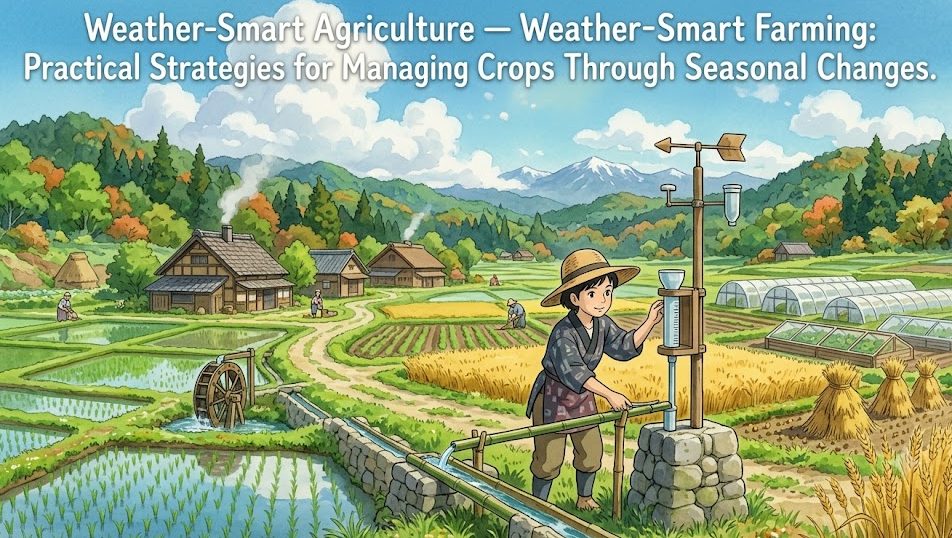
Weather is one of the biggest variables in agriculture. A farm can have healthy soil, quality seeds, good equipment, and careful management, yet changing weather can still influence planting, crop growth, irrigation, pest activity, harvesting, and overall farm performance.
Weather-smart farming is an approach that focuses on preparing for changing conditions instead of relying on a fixed production schedule. It combines weather observation, crop selection, soil management, water planning, technology, and flexible decision-making to help farmers respond to seasonal changes.
For farms across the United States, this approach can be particularly useful because weather patterns vary widely between regions. A grower in the Midwest may deal with freezing temperatures and heavy spring rainfall, while a farm in the Southwest may focus more heavily on heat and water availability. Southern farms may experience long warm seasons but still face occasional freezes, storms, or excessive rainfall.
Weather-smart farming does not mean predicting every weather event. Instead, it means creating a farm management system that can adjust when conditions are different from expectations.
What Makes a Farm Weather-Smart?
A weather-smart farm pays attention to three things:
What is happening now?
What is likely to happen next?
What can be changed before conditions become a problem?
This mindset encourages farmers to move away from purely calendar-based decisions.
For example, planting on the same date every year may not always make sense. If soil remains cold and wet, delaying planting may produce better establishment. If temperatures rise unusually early, an earlier planting window might become possible for certain crops.
The right decision depends on the crop, soil, local climate, and available resources.
Build a Farm Weather Routine
Weather information becomes much more useful when farmers check it consistently.
A simple routine can include reviewing:
- Short-term temperature forecasts
- Rainfall predictions
- Wind conditions
- Frost risk
- Heat conditions
- Soil moisture
- Storm warnings
- Long-term seasonal patterns
Farmers can combine official forecasts with observations from their own fields.
A weather station located near the farm can sometimes provide more useful information than a distant weather report because conditions can vary significantly across relatively short distances.
Useful measurements may include temperature, rainfall, humidity, wind speed, and soil moisture.
The goal is not to collect data simply because technology makes it possible. Each measurement should support a farming decision.
Use Weather Information Before Planting
Weather-smart farming begins before seeds enter the ground.
Planting decisions should consider whether the upcoming conditions are suitable for crop establishment.
Important questions include:
- Is the soil warm enough?
- Is the soil too wet?
- Is frost still a significant risk?
- Is heavy rainfall expected?
- Is the field ready for equipment?
- Does the crop have enough time to mature?
- Could extreme heat arrive soon after emergence?
Planting into poor conditions can create problems that are difficult to correct later.
For example, working wet soil can increase compaction, while planting sensitive crops before a damaging freeze can result in poor establishment.
A short delay may sometimes be less damaging than forcing the crop into unsuitable conditions.
Select Crops for the Local Weather Environment
Crop selection should reflect the climate in which the farm operates.
Cool-season crops generally perform better during lower temperatures, while warm-season crops require suitable heat for growth.
Farmers should also consider varieties within each crop.
Varieties may differ in:
- Maturity time
- Heat tolerance
- Cold tolerance
- Disease resistance
- Drought response
- Water requirements
- Growth habit
Choosing an appropriate variety can provide another layer of protection against seasonal uncertainty.
For example, an earlier-maturing variety may be useful in a region where the growing season is relatively short, while heat-tolerant varieties may be more suitable for areas that experience prolonged summer temperatures.
Protect Soil From Weather Extremes
Healthy soil can help a farm handle changing weather more effectively.
Heavy rain can cause erosion and nutrient movement, while prolonged dry periods can reduce soil moisture. Compacted soil can make both problems worse by limiting infiltration and root development.
Practical soil-protection methods include:
- Cover crops
- Mulching
- Reduced tillage
- Crop rotation
- Maintaining organic matter
- Managing field traffic
- Improving drainage
- Protecting soil from erosion
Keeping living roots or protective plant residue on the soil when appropriate can reduce exposure to rain and wind.
Good soil structure can also help water move into the soil during rainfall while allowing crops to access stored moisture during drier periods.
Manage Water Before It Becomes a Problem
Water management is central to weather-smart agriculture.
Farmers often have to deal with two opposite situations: too much water and too little water.
During wet periods, good drainage can prevent standing water and root problems. During dry periods, efficient irrigation can help maintain crop growth without unnecessary water use.
Weather-smart irrigation can include:
- Soil moisture monitoring
- Weather-based irrigation scheduling
- Drip irrigation
- Efficient sprinklers
- Proper field drainage
- Mulching
- Water storage
- Checking irrigation equipment regularly
Instead of irrigating according to a fixed schedule, farmers can consider soil moisture, recent rainfall, upcoming weather, crop growth stage, and expected evaporation.
Prepare for Heat Stress
Extreme heat can affect crops even when water is available.
High temperatures can increase water demand and may interfere with flowering, pollination, fruit development, or overall plant growth depending on the crop.
Farmers can reduce heat-related risk by:
- Selecting suitable varieties
- Maintaining adequate soil moisture
- Using mulch
- Improving irrigation efficiency
- Adjusting planting dates
- Providing shade where appropriate
- Maintaining good soil health
- Monitoring crops during hot periods
The most vulnerable growth stage varies by crop. A plant may tolerate heat during one stage but become much more sensitive during flowering or fruit development.
Knowing the crop’s growth cycle therefore helps farmers focus attention where it matters most.
Prepare for Frost and Freezing Conditions
Cold weather can create sudden risks, especially during spring and fall transitions.
Frost protection strategies may include:
- Delaying planting
- Selecting cold-tolerant varieties
- Using row covers
- Growing under tunnels
- Starting plants indoors
- Monitoring local temperatures
- Harvesting vulnerable crops before severe cold
Farmers should also consider infrastructure.
Water lines, irrigation systems, greenhouse equipment, and other exposed components may need protection when freezing conditions are expected.
Preparation is generally easier before the temperature drops than during an active freeze.
Manage Heavy Rainfall
Heavy rainfall can create several agricultural problems at once.
Excess water can:
- Flood fields
- Reduce soil oxygen
- Delay planting
- Increase erosion
- Move nutrients
- Damage young plants
- Increase disease pressure
Field drainage should therefore be considered part of weather-smart farm design.
Farmers can use appropriate drainage systems, contour practices, grassed waterways, raised beds, cover crops, and other soil-conservation methods depending on the landscape.
Avoiding unnecessary equipment traffic on saturated fields is also important because wet soil is highly vulnerable to compaction.
Adjust Fertilizer Decisions to Weather
Weather can influence how nutrients behave in the soil.
Heavy rainfall can increase the movement of certain nutrients beyond the root zone, while drought can limit nutrient movement and plant uptake.
This means fertilizer decisions should not always follow a fixed calendar.
Farmers can consider:
- Soil test results
- Crop requirements
- Expected rainfall
- Irrigation
- Crop growth stage
- Previous nutrient applications
Applying large amounts of fertilizer immediately before heavy rainfall may be inefficient and can increase the risk of nutrient movement.
A weather-aware fertility plan can help farmers use inputs more carefully.
Watch How Weather Changes Pest and Disease Pressure
Weather can influence insects, plant diseases, and other crop-health problems.
Warm and humid conditions may create favorable environments for certain diseases, while changes in temperature can influence insect activity.
Instead of automatically applying treatments, farmers can monitor fields and use integrated pest management principles.
This can include:
- Regular scouting
- Crop rotation
- Resistant varieties
- Field sanitation
- Beneficial organisms
- Physical controls
- Targeted treatments when appropriate
Weather information can help determine when increased scouting may be worthwhile.
Use Protected Agriculture as a Weather Buffer
Greenhouses, high tunnels, row covers, and other protected systems can provide additional control over the growing environment.
They can reduce exposure to:
- Frost
- Strong winds
- Heavy rain
- Certain temperature extremes
- Some pest pressures
Protected systems are especially useful for extending the growing season.
However, they still require careful management. A greenhouse can become excessively warm on a sunny day, even when outdoor temperatures are relatively low. Ventilation, irrigation, humidity, and crop spacing therefore remain important.
Create Backup Plans for Major Weather Events
One of the strongest weather-smart strategies is having a backup plan.
For each major crop, farmers can identify potential responses to common weather problems.
For example:
If planting is delayed:
Consider an earlier-maturing variety or another suitable crop.
If rainfall is excessive:
Prioritize drainage and avoid unnecessary field traffic.
If drought develops:
Protect high-value crops and adjust irrigation according to crop priority.
If extreme heat arrives:
Monitor water demand and vulnerable growth stages more closely.
If frost is expected:
Use available protection or delay planting where possible.
If a crop is badly damaged:
Evaluate whether replanting, harvesting early, or switching to another production plan makes economic sense.
A backup plan does not eliminate losses, but it can reduce the time required to make decisions during stressful conditions.
Diversify the Farm’s Weather Exposure
Crop diversification can help distribute risk.
A farm that depends entirely on one crop may be highly exposed to a specific weather problem. If that crop is particularly sensitive to heat, drought, excessive rainfall, or frost, one major weather event could affect a large portion of the operation.
A more diversified system may include crops with different:
- Planting periods
- Maturity dates
- Temperature preferences
- Water requirements
- Root depths
- Harvest windows
This does not guarantee stable production, but it can prevent all farm income or food production from depending on one environmental outcome.
Use Technology With a Clear Purpose
Weather-smart agriculture does not require every available technology.
Farmers should start with the decisions they need to improve.
Useful tools can include:
- Automated weather stations
- Soil moisture sensors
- Soil temperature sensors
- Irrigation controllers
- Weather forecasting applications
- Satellite imagery
- GPS mapping
- Crop-monitoring platforms
- Farm-management software
A small farm may gain more value from one reliable weather station and good records than from a complicated system that produces large amounts of data but does not improve decisions.
Technology should make farming easier to manage, not create unnecessary complexity.
Keep Records and Learn From Each Season
Weather-smart farming improves over time.
Farmers should record both successful and unsuccessful decisions.
Useful records include:
- Planting dates
- Crop varieties
- Temperature conditions
- Rainfall
- Frost events
- Heat periods
- Irrigation
- Fertilizer applications
- Pest activity
- Disease problems
- Harvest dates
- Yield
- Crop losses
After several seasons, these records can reveal patterns.
A farmer may discover that a particular field consistently becomes too wet during early spring, or that one variety performs better during hot summers.
This information can make future decisions more practical and less dependent on guesswork.
A Simple Weather-Smart Decision Framework
A practical system can be built around five questions:
1. What is the crop facing now?
Check soil, plant growth, moisture, temperature, pests, and current weather.
2. What weather is coming?
Review short-term forecasts and identify potential risks.
3. Which crop stage is most vulnerable?
Flowering, germination, transplanting, fruit development, and other stages may respond differently to weather.
4. What action can reduce the risk?
Possible actions include irrigation changes, protective covers, delayed fieldwork, drainage management, scouting, or adjusting harvest timing.
5. What happened afterward?
Record the result and use it to improve the next decision.
This simple cycle can be repeated throughout the growing season.
Final Thoughts
Weather-smart farming is not about controlling the weather. It is about improving the farm’s ability to respond to it.
Farmers can become more weather-ready by combining local climate knowledge with healthy soil, efficient water management, appropriate crop varieties, crop diversification, weather monitoring, protected growing systems, and flexible decision-making.
The most valuable strategy may be to avoid depending on a single plan. A strong farm plan should have room to change when planting is delayed, rainfall increases, temperatures rise, or an unexpected cold event arrives.
For farms across the United States, local conditions should always guide the final decision. What works in one region may not work in another.
By observing the field, monitoring weather, keeping useful records, and making adjustments throughout the season, farmers can build a more adaptable production system that is better prepared for changing weather conditions.