Did you know that over 20% of global crop losses are directly attributed to excessive rainfall, unpredictable flooding, and poorly drained soils?
For farmers, homesteaders, and agricultural entrepreneurs operating in high-precipitation zones, watching a season’s hard work drown in waterlogged earth is a devastating reality. Prolonged standing water suffocates traditional plant roots, leading to immediate root rot, rampant fungal diseases, and the rapid leaching of vital soil nutrients. This constant battle against the weather can quickly turn a highly profitable harvest into a total financial loss.
The ultimate solution isn’t trying to fight the torrential weather; it’s adapting to it. By strategically cultivating water-resistant crops—plants naturally equipped with the biological mechanics to thrive in soggy conditions—you can transform your wettest fields from liabilities into your most productive assets.
In this comprehensive guide, we will explore the core fundamentals of water-tolerant agriculture, outline the immense benefits of planting rain-hardy varieties, provide a practical step-by-step implementation guide for beginners, and discuss the future trends shaping high-rainfall farming.
Understanding Water-Resistant Crops: Key Concepts and Importance
Cultivating crops in heavy rain areas requires a fundamental understanding of plant biology. Unlike standard vegetables that drown when soil oxygen is displaced by water, water-resistant crops possess specialized adaptations. Many of these plants feature aerenchyma tissues—hollow channels in their stems and roots that allow oxygen to travel from the leaves above the water straight down into the submerged root system.
Historically, ancient civilizations thriving in monsoon climates relied heavily on water-loving staples. From the terraced paddies of Asia to the ancient taro patches of Polynesia, farmers have long understood that working with water yields better results than fighting it. Today, optimizing land use in heavy rainfall regions is more critical than ever for maintaining a sustainable and highly profitable agricultural business.
Think of a standard agricultural plant like a paper straw—leave it in a glass of water too long, and it completely disintegrates. A true water-resistant plant, however, is like a highly efficient mechanical water pump. It is biologically designed to actively channel excess water, maintain its structural integrity, and “breathe” efficiently even when temporarily submerged.
The Top 10 Water-Resistant Crops for Heavy Rain
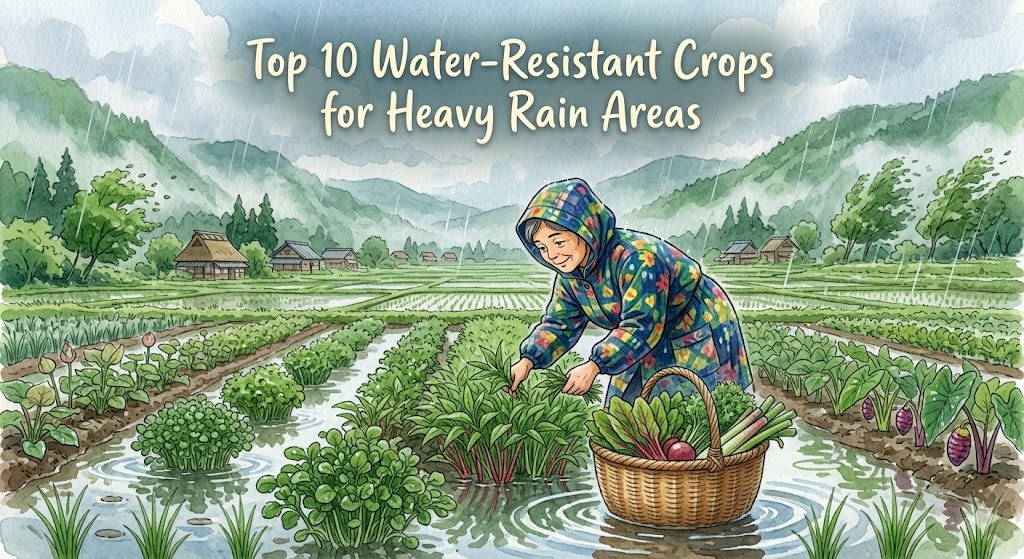
To succeed, you must plant the right seeds. Here are the top ten crops best suited for heavy rain environments:
- Taro (Colocasia esculenta): A staple root crop that actively thrives in swampy, flooded mud.
- Water Spinach (Kangkong): A fast-growing leafy green that grows natively in wetlands.
- Rice (Paddy Varieties): The ultimate flood-tolerant cereal grain.
- Cranberries: Grown in bogs, these tart berries require heavy water saturation.
- Watercress: A highly profitable, nutrient-dense green that loves running water.
- Lotus Root: An aquatic plant cultivated for its crunchy, edible rhizomes.
- Arrowhead (Sagittaria): A wetland tuber that thrives in standing water.
- Celery: Requires massive amounts of continuous moisture for crisp stalk development.
- Cabbage: Certain heavy-headed varieties can tolerate high rainfall if drainage is adequate.
- Mint: A vigorous herb that loves damp, saturated soil and spreads rapidly.
Why It Matters: The Top Benefits of Cultivating Water-Resistant Crops
Shifting your focus to rain-hardy agriculture offers incredible advantages that traditional dryland farming simply cannot match. Here is why making this transition matters:
- Guaranteed Yields in Extreme Weather: By planting crops that naturally resist flooding, you secure your food supply and protect your commercial income even during the most severe monsoon seasons.
- Reduced Disease Susceptibility: Standard crops in wet soil quickly succumb to blight and mildew. Water-resistant plants have evolved natural immunities to common waterborne pathogens.
- Lower Infrastructure Costs: Instead of spending thousands of dollars on complex underground French drains and heavy-duty water pumps, you can utilize the land exactly as it is.
- Maximized Land Utilization: Every farm has that one “swampy” low spot where nothing seems to grow. Water-tolerant crops allow you to turn previously dead zones into highly profitable, high-yielding cultivation areas.
Pro Fact: A mature Taro plant can absorb and transpire up to three times more water than standard root vegetables, acting as a natural, biological bio-drain for overly saturated farm soil!
How to Get Started: A Practical Guide for Beginners
Transitioning your farming strategy to accommodate heavy rainfall requires practical planning. Follow this 5-step actionable plan to ensure your wet-weather crops thrive.
Step 1: Assess Your Soil’s Drainage Capacity Before planting, dig a hole 12 inches deep and fill it with water. If the water takes more than 24 hours to drain, you have heavy, poorly draining soil perfectly suited for aquatic or semi-aquatic crops like Water Spinach or Taro.
Step 2: Choose Your Crop Based on Water Depth Not all water-resistant crops are the same. If your land experiences shallow puddling, choose moisture-loving crops like celery and mint. If your land experiences deep, standing water for days at a time, pivot entirely to paddy rice or lotus root.
Step 3: Implement Raised Bed Systems Even water-resistant plants benefit from oxygen. Build raised earthen beds or wooden planter boxes. This allows the roots to reach down into the moisture while keeping the main crown of the plant safe from total, permanent submersion.
Step 4: Adjust Your Planting Schedule Time your seed starting and transplanting carefully. Transplant robust, established seedlings into the field just before the heaviest rainy season begins. Young seeds can be easily washed away by torrential downpours, but strong seedlings will anchor the soil.
Step 5: Utilize Heavy Organic Mulching Apply a thick layer of heavy organic mulch, such as coarse wood chips or dense straw, around the base of your plants. This prevents the heavy, pounding rain from eroding your precious topsoil and splashing soil-borne fungal spores onto the leaves.
Beginner’s Tip: Never compress or walk heavily on wet, waterlogged soil! Compacting wet earth completely destroys its internal structure, removing the microscopic air pockets that even water-resistant roots desperately need to survive.
To execute this effectively, ensure you have basic tools like a sturdy broadfork for aeration, heavy-duty raised bed materials, and access to high-quality organic compost to replenish nutrients lost to rain runoff.
Overcoming Challenges and Looking into the Future
Farming in high precipitation is not without its hurdles. One of the most common challenges is nutrient leaching, where heavy rains wash away vital nitrogen and potassium from the topsoil. You can solve this by switching entirely to slow-release, organic fertilizers (like pelleted poultry manure or bone meal) that break down gradually, resisting the washout effect. Another hurdle is decreased airflow causing foliar diseases; this is easily managed by widening the spacing between your plants to allow maximum wind circulation.
Looking into the future, the agricultural industry is rapidly adapting to extreme weather. Innovations in CRISPR gene-editing are currently developing “super-varieties” of traditional crops engineered to withstand up to two weeks of complete underwater submersion. Furthermore, precision agriculture utilizing AI-driven moisture sensors is helping farmers map exactly how water moves across their land, allowing for hyper-optimized planting zones.
Conclusion
Successfully cultivating crops in heavy rain areas is entirely possible when you stop fighting the climate and start working with it. By understanding the biology of water-resistant plants, leveraging their natural economic and environmental benefits, and implementing a smart, raised-bed strategy, you can turn a flooded field into a flourishing harvest.
Your Next Step: After the next heavy rainfall in your area, walk your property and identify the spots where water naturally pools and sits the longest. Plan to plant your first test patch of Taro, Mint, or Watercress in that exact location this coming season.
Let the heavy rain become your greatest agricultural asset, not your biggest fear!
Frequently Asked Questions (FAQs)
1. Can tomatoes survive in heavy rain areas? Standard tomatoes perform very poorly in heavy rain, as they are highly susceptible to blight and root rot. If you must grow them in wet regions, use elevated containers, rain shelters, and disease-resistant hybrid varieties.
2. How do I stop the rain from washing away my seeds? Start your seeds indoors or in a greenhouse. Only transplant them into the outdoor field once they have developed a strong, sturdy root system (usually 4-6 weeks old) that can anchor them against heavy downpours.
3. What is the fastest-growing crop for a waterlogged garden? Water Spinach (Kangkong) and Watercress are incredibly fast-growing. Under the right warm and wet conditions, Water Spinach can often be harvested just 30 to 40 days after planting.
4. Do water-resistant crops still need fertilizer? Yes, they do. However, because heavy rain washes away synthetic, water-soluble fertilizers almost instantly, it is highly recommended to use slow-release organic composts or granular organic fertilizers mixed deep into the soil.