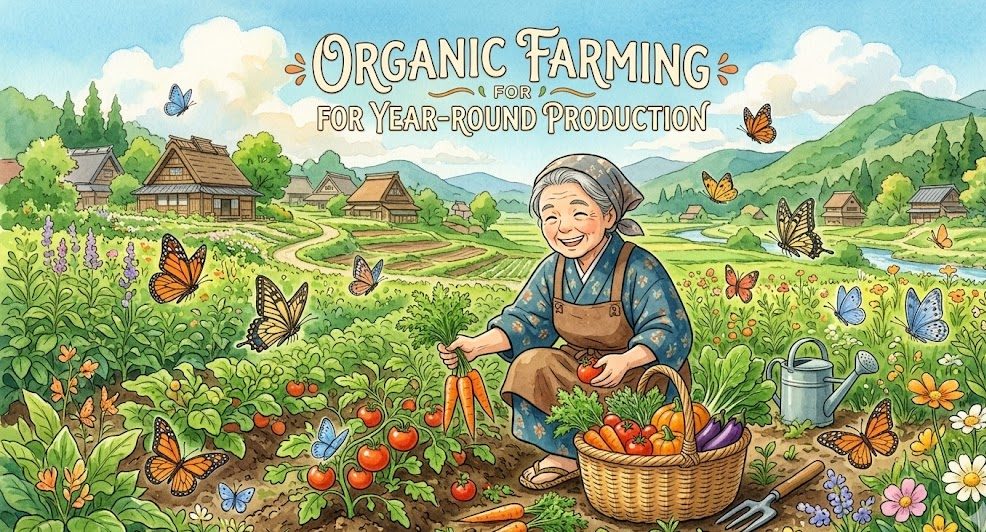
Did you know that traditional seasonal farming leaves incredibly valuable agricultural land completely dormant and unprofitable for up to five months of every single year?
For generations, farmers and passionate homesteaders have accepted the arrival of the first winter frost as the definitive end of their income stream. This deeply ingrained seasonal cycle creates a massive financial “Pain Point.” When the fields are empty, the cash flow completely stops, skilled agricultural laborers are laid off, and the exposed, bare topsoil becomes highly vulnerable to severe winter erosion. Waiting endlessly for the spring thaw while relying entirely on savings from the summer harvest is a highly stressful, outdated business model.
The ultimate, highly profitable solution is the transition to organic farming for year-round production. By strategically combining ancient soil-building techniques with modern season-extension infrastructure, ambitious growers can entirely bypass the limitations of their local climate and harvest fresh, premium produce 365 days a year.
In this comprehensive guide, we will explore the core fundamentals of perpetual organic harvesting, break down the immense economic and environmental benefits, provide a practical step-by-step implementation plan for your farm, and navigate the unique challenges of continuous cultivation.
Understanding Organic Farming for Year-Round Production: Key Concepts and Importance
At its core, year-round organic production is the meticulous synchronization of crop genetics, microclimate manipulation, and aggressive soil regeneration. It is the deliberate rejection of the “off-season.” Instead of allowing the farm to shut down, growers utilize structures like unheated high tunnels, cold frames, and heavy organic mulching to create artificial, temperate pockets of life even in the dead of winter or the scorching heat of mid-summer.
Historically, humans were entirely bound by their regional climates, forced to preserve summer food in root cellars to survive the winter. Today, with the skyrocketing consumer demand for local, chemical-free produce every month of the year, continuous cultivation has transformed from a survival tactic into a highly lucrative modern agribusiness strategy.
Think of traditional seasonal farming like a manufacturing factory that completely shuts off its assembly line every November, leaving the machinery to rust until April. Year-round organic farming is like a well-oiled, 24/7 manufacturing plant. As soon as the summer tomato production line finishes, the winter spinach and kale assembly line immediately fires up. The factory never closes, the workers stay employed, and the highly valuable end-product never stops rolling out the door.
Why It Matters: The Top Benefits of Year-Round Organic Farming
Transitioning your agricultural operation from a fleeting summer sprint into a continuous, year-round marathon offers incredible advantages that traditional competitors completely miss out on. Here is why prioritizing a 365-day harvest matters:
- Uninterrupted Cash Flow: The most obvious benefit is financial stability. By harvesting high-value crops in November, January, and March, you create a steady, predictable income stream that completely eliminates the dreaded “winter financial drought.”
- Absolute Market Dominance: When 90% of local farms shut down for the winter, the supply of fresh regional produce plummets. This allows year-round organic growers to step in and command premium, top-tier pricing at winter farmers’ markets and local restaurants.
- Exceptional Labor Retention: Seasonal farming forces you to hire and fire your best workers every single year. Year-round production allows you to offer stable, permanent employment, ensuring you retain highly skilled, deeply experienced farmhands.
- Enhanced Soil Biology: Mother Nature hates bare dirt. Keeping living plant roots actively growing in the soil for 12 straight months continuously feeds the microscopic soil biome, prevents severe wind erosion, and builds incredible, long-term soil fertility.
Pro Fact: Commercial organic farms that utilize basic, unheated high tunnels for winter greens production frequently report an overall annual revenue increase of up to 40% per acre compared to their summer-only operations!
How to Get Started: A Practical Guide for Beginners
Shifting your farm to a perpetual harvest model requires rigorous planning and the right infrastructure. Follow this 5-step actionable plan to ensure your fields never stop producing.
1. Invest in Season Extension Infrastructure
You cannot fight extreme weather without physical protection. Invest in high tunnels (also known as hoop houses) or low caterpillar tunnels.
These simple, unheated structures covered in greenhouse plastic trap the sun’s radiant heat, effectively moving your farm’s microclimate one or two growing zones southward.
2. Master Crop Succession Planning
Year-round farming is entirely about timing. You must master succession planting. As soon as a spring crop (like radishes) is harvested, a summer crop (like peppers) must be transplanted into that exact same space within 48 hours. When the peppers die in the fall, winter spinach must immediately take their place. Never leave a garden bed empty.
3. Select Climate-Resilient Seed Genetics
Stop trying to grow summer crops in the snow. You must pivot your seed selection based on the season. Plant extreme heat-tolerant varieties (like okra and sweet potatoes) for the peak of summer, and incredibly cold-hardy overwintering varieties (like Siberian kale, mache, and carrots) for the deep winter.
4. Implement Aggressive Composting
When you demand 365 days of production from your soil, you must feed it 365 days a year. Because you are constantly extracting nutrients through continuous harvesting, you must aggressively top-dress your beds with rich, organic compost between every single crop rotation to prevent the earth from becoming utterly exhausted.
5. Utilize Double-Coverage Techniques
For regions with severe, sub-zero winters, a high tunnel alone is not enough. You must utilize the “blanket inside a tent” method. Place lightweight, spun-bonded floating row covers directly over the crops inside your high tunnel to create a hyper-insulated microclimate that keeps the soil from freezing solid.
Beginner’s Tip: The biggest mistake beginners make is planting their winter crops too late! Winter crops must be planted in late summer or early autumn so they reach 75% of their mature size before the winter days drop below 10 hours of sunlight.
To execute this properly, you will need commercial-grade greenhouse plastic, galvanized steel hoops, floating row covers, soil blockers for continuous seed starting, and an endless supply of high-quality compost.
Overcoming Challenges and Looking into the Future
Operating an organic farm without a seasonal break comes with distinct operational hurdles. The most common challenge is winter humidity management. Tightly sealed high tunnels trap massive amounts of moisture from the soil, leading to devastating outbreaks of downy mildew and botrytis (gray mold). You can successfully solve this by manually rolling up the sides of your tunnels for just 30 minutes on sunny winter afternoons to completely flush out the damp, stale air.
Another serious hurdle is soil fatigue. Continuously working the earth can destroy its natural structure. Progressive farmers mitigate this by occasionally rotating a fast-growing, nitrogen-fixing cover crop (like crimson clover) into their succession plan for just four weeks to act as a “green manure” before the next cash crop is planted.
Looking to the future, the year-round organic farming industry is embracing brilliant, low-carbon innovations. We are witnessing the rapid adoption of Climate Batteries (Subterranean Heating and Cooling Systems). These systems use small solar-powered fans to capture the hot daytime air from the top of a greenhouse and pump it deep underground into buried pipes, storing the heat in the earth itself, and then passively releasing that exact warmth back up to the plants during the freezing night.
Conclusion
Organic farming for year-round production completely shatters the traditional limitations of agriculture. By understanding the vital mechanics of season extension, leveraging the massive economic benefits of off-season market dominance, and strictly managing your soil health, you can build an incredibly resilient, unstoppable agribusiness.
Your Next Step: Grab a calendar today and select just one garden bed or field row. Write down a strict three-crop succession plan for that specific space: a spring green, a heavy summer fruiting crop, and a cold-hardy winter root vegetable.
The earth never truly sleeps, and with the right organic strategies, your harvest and your profits won’t have to either!
Frequently Asked Questions (FAQs)
1. What are the absolute best crops to grow during the winter months? Cold-hardy leafy greens and root vegetables are the undisputed champions of winter farming. Spinach, kale, Swiss chard, arugula, carrots, and turnips actively thrive in cooler temperatures and actually become significantly sweeter after experiencing a frost.
2. Does farming year-round deplete the soil faster? It will deplete the soil if you do not actively manage it. Because you are extracting nutrients continuously, you must replenish them continuously. Relying heavily on rich organic compost, worm castings, and strategic cover-cropping ensures the soil remains incredibly fertile year after year.
3. Do I need expensive electric heaters for my winter high tunnels? No, you do not. The vast majority of profitable, year-round organic farms rely entirely on passive solar heating. By combining the greenhouse effect of the high tunnel with an internal layer of agricultural fabric directly over the plants, you can successfully grow cold-hardy crops without ever paying for electricity or propane.
4. How do I transition my current seasonal farm to a year-round model? Start small and scale slowly. Do not attempt to cover your entire farm in high tunnels in year one. Purchase and erect a single 50-foot caterpillar tunnel this autumn. Use it to experiment with overwintering spinach and carrots to master the timing and ventilation before expanding your infrastructure.