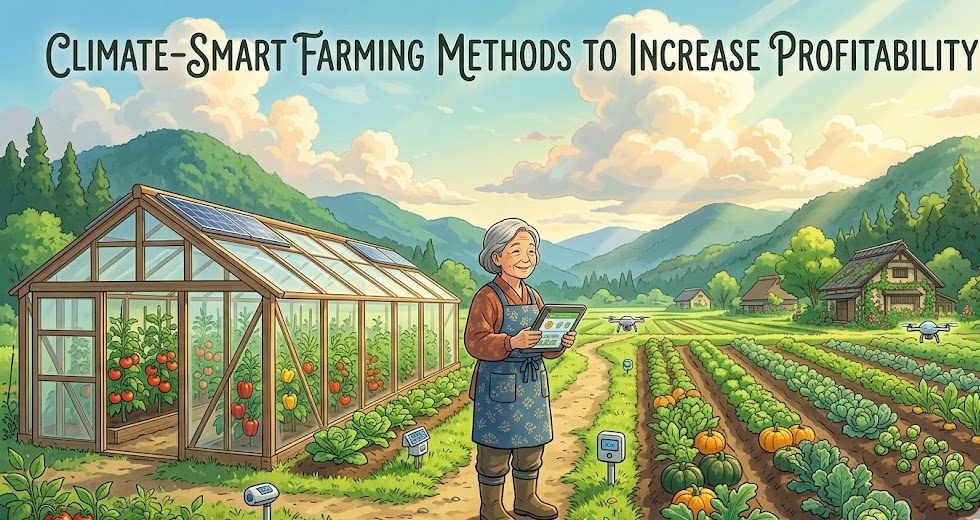
Did you know that extreme weather events have wiped out an estimated $30 billion in global crop value over the last decade alone?
For modern agricultural professionals, the climate is no longer a predictable partner; it has become the biggest financial liability. Unprecedented droughts, sudden flash floods, and blistering heat domes are actively destroying seasonal yields and driving up expensive input costs like water and synthetic fertilizers. Sticking to traditional, rigid farming practices in the face of this unpredictable weather creates a massive “Pain Point.” You end up working twice as hard and spending twice as much money, only to watch a single unseasonal storm wash your profit margins entirely away.
The ultimate solution to this volatility is the adoption of climate-smart farming methods. By shifting to adaptive, scientifically proven agricultural practices, you can drastically reduce your environmental risks while simultaneously maximizing your financial returns.
In this comprehensive guide, we will explore the core fundamentals of climate-smart agriculture, unpack the incredible economic benefits it provides, offer a practical step-by-step implementation plan for beginners, and look at the highly profitable future of resilient farming.
Understanding Climate-Smart Farming: Key Concepts and Importance
At its core, Climate-Smart Agriculture (CSA) is an integrated approach to managing farmland that addresses the interlinked challenges of food security and climate change. The framework rests on three main pillars: sustainably increasing agricultural productivity (profitability), adapting and building resilience to extreme weather, and reducing greenhouse gas emissions wherever possible. Historically, farming focused solely on extracting maximum yield from the dirt. Today, CSA views the farm as a dynamic, living ecosystem that must be carefully balanced and protected to ensure long-term commercial survival.
Think of a traditional farming operation like a rigid glass building—it is strong and functional in perfect conditions, but it shatters completely during an earthquake. Climate-smart farming is like a modern skyscraper engineered with flexible shock absorbers. It is specifically designed to sway, adapt, and absorb the tremors of extreme droughts or sudden floods without ever collapsing. By building flexibility directly into the soil and the crop selection, the farm easily survives the “earthquakes” of modern climate change.
Why It Matters: The Top Benefits of Climate-Smart Farming
Transitioning your agricultural business to a climate-smart model is not just an environmental ideal; it is a highly calculated, profit-driven business strategy. Here is why prioritizing these resilient methods matters for your bottom line:
- Drastically Reduced Input Costs: By implementing precision irrigation and utilizing natural biological fertilizers (like cover crops), you significantly slash your monthly spending on municipal water and expensive synthetic chemicals.
- Stabilized Yields in Extreme Weather: Utilizing drought-resistant seeds and advanced soil moisture retention techniques ensures that you will always have a harvest to sell, even when neighboring traditional farms completely fail during a heatwave.
- Access to Premium Markets: Modern consumers and high-end restaurant chefs are actively seeking out, and paying premium prices for, sustainably grown produce. Climate-smart certifications allow you to position your brand as a top-tier, eco-conscious supplier.
- New Revenue Streams: Climate-smart practices like minimal tillage actually trap carbon in the ground. Many governments and private corporations are now paying farmers direct cash incentives (carbon credits) simply for practicing carbon farming.
Pro Fact: Implementing basic conservation tillage can increase your soil’s natural moisture retention capacity by up to 20%, saving commercial farms thousands of dollars in emergency irrigation costs during severe summer droughts!
How to Get Started: A Practical Guide for Beginners
Transforming a vulnerable farm into a highly resilient, profitable operation requires strategic, incremental changes. Follow this 5-step actionable plan to begin implementing climate-smart methods today.
1. Conduct a Climate Risk Assessment
Before changing your operation, you must identify your weakest links. Review your region’s weather data from the last five years. Are you losing money mostly to early frosts, mid-summer droughts, or heavy soil erosion from flash floods? Identify your primary climate threat so you can target your financial investments precisely.
2. Transition to Minimum Tillage (No-Till)
Stop aggressively plowing your fields every season. Deep tilling destroys the natural, sponge-like structure of the soil and releases vital moisture into the air. Switch to minimum tillage or no-till planters. This leaves the previous season’s crop residue on the surface, creating a natural armor that prevents erosion and traps moisture deep in the earth.
3. Diversify Crop Rotations and Cover Crops
Monoculture (planting the exact same crop every year) exhausts the soil and invites devastating pests. Implement a strict crop rotation schedule and always plant a living cover crop (like clover or winter rye) during the off-season. These plants naturally fix free atmospheric nitrogen into the soil, acting as a powerful, zero-cost biological fertilizer for your next cash crop.
4. Implement Precision Water Management
Never rely on wasteful overhead flood irrigation. Upgrade to commercial drip irrigation systems connected to digital soil moisture sensors. This technology ensures that water is delivered exclusively to the plant’s root zone exactly when the plant needs it, eliminating evaporation waste and lowering your pumping costs.
5. Integrate Agroforestry
Plant strategic rows of native trees and large perennial shrubs along the borders of your crop fields. These windbreaks physically shield your delicate cash crops from violent, crop-snapping gales. Furthermore, their deep roots stabilize the local water table, and they create a cooler, shaded microclimate that drastically reduces soil evaporation.
Beginner’s Tip: Do not attempt to overhaul your entire 100-acre farm into a no-till, cover-cropped system in a single season. The learning curve is steep. Start by applying these climate-smart methods to a single 10% “test plot” to master the new machinery and timing before scaling up.
To execute this properly, you will need access to no-till seeding equipment, a reliable drip irrigation kit, high-quality cover crop seeds, and a digital soil testing kit to monitor your improving organic matter.
Overcoming Challenges and Looking into the Future
Shifting to a new agricultural paradigm comes with distinct operational hurdles. The most significant challenge is the initial transition cost. Purchasing specialized no-till seeders or outfitting an entire farm with drip irrigation requires upfront capital. You can successfully navigate this by applying for local government agricultural grants, which are currently pouring billions of dollars into subsidizing climate-smart infrastructure for transitioning farmers.
Another hurdle is the temporary dip in crop yields during the first year or two as the exhausted, chemically dependent soil slowly rebuilds its natural biological fertility. Patience and strict adherence to organic composting are required to push through this brief transition phase.
Looking into the future, the integration of climate-smart farming and high-tech automation is creating an agricultural renaissance. We are seeing the massive commercial rollout of AI-driven weather modeling algorithms. These systems analyze localized climate data to tell farmers exactly which drought-resistant seed strain to plant to maximize profits for that specific, upcoming season. Additionally, advancements in CRISPR technology are continuously developing “super-crops” that maintain massive yields while requiring half the water of traditional plants.
Conclusion
Climate-smart farming is no longer just an ecological buzzword; it is the ultimate blueprint for modern agricultural profitability. By understanding the critical mechanics of soil health, leveraging the immense financial benefits of resource conservation, and implementing strategic practices like cover cropping and precision irrigation, you can completely future-proof your agribusiness.
Your Next Step: Purchase a simple bag of crimson clover or winter rye seeds today. The moment your current cash crop is harvested, broadcast these seeds over a single test bed to witness the incredible soil-building power of cover crops firsthand.
Stop gambling with the weather. Farm smarter, adapt to the climate, and watch your profits grow stronger year after year!
Frequently Asked Questions (FAQs)
1. Does no-till farming really save money? Absolutely. While you may need to rent or buy a new type of planter initially, no-till farming drastically reduces the number of times you have to drive a heavy tractor across the field. This cuts your diesel fuel consumption, machinery wear-and-tear, and physical labor costs by up to 40%.
2. What are “carbon credits” in farming? When you practice climate-smart methods like cover cropping and zero-tillage, your soil pulls carbon dioxide out of the atmosphere and locks it underground. Many corporations will now pay you cash for every ton of carbon you sequester, creating a highly profitable secondary income stream for your farm.
3. Will cover crops steal water from my main cash crop? No, if managed correctly. Cover crops are grown during the off-season when your fields would normally sit empty. Before planting your main cash crop, the cover crop is terminated (crimped or mowed), turning into a thick, moisture-retaining mulch that actually saves water during the hot summer.
4. Can small-scale or urban farms practice climate-smart agriculture? Yes! The principles of CSA apply perfectly to any scale. A small urban farm can easily implement precision drip irrigation, heavy mulching, and intense crop rotation to maximize their yield-per-square-foot while minimizing their municipal water bills.