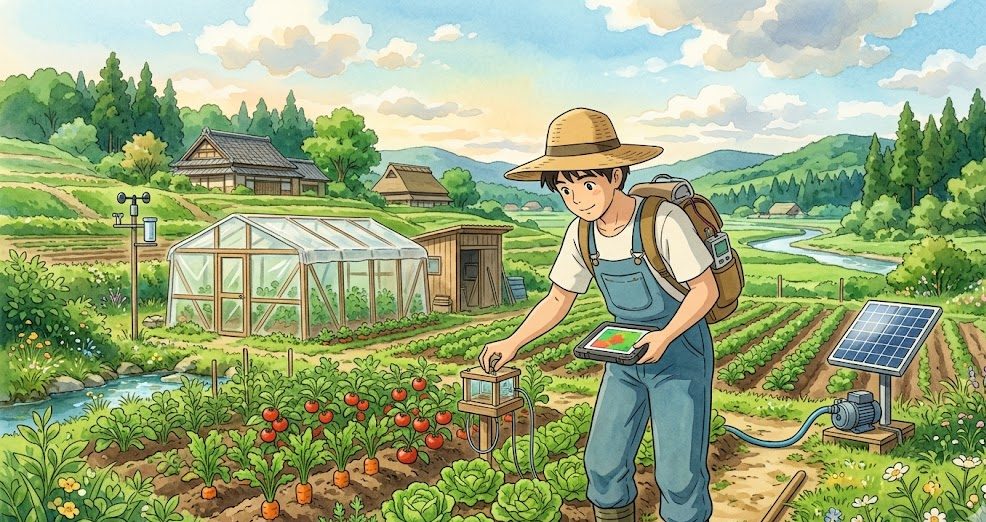
When you hear terms like “Smart Farming,” “Artificial Intelligence,” or “Precision Agriculture,” it is easy to picture multi-million dollar corporate farms. You might imagine self-driving tractors guided by military-grade GPS, autonomous drones scanning thousands of acres, and ultra-expensive automated glass greenhouses.
If you are a beginner, a small-scale homesteader, or a family farmer with a tight budget, this high-tech vision can feel incredibly intimidating. You might think, “This technology isn’t meant for me.”
But here is the big secret: Precision farming is not about how much money you spend; it is about how wisely you use your resources.
At its core, precision agriculture simply means doing the right thing, in the right place, at the right time. By starting small, utilizing open-source tools, and focusing on DIY tech, you can implement smart farming on your land without breaking the bank. Here is your complete beginner’s guide to building a high-tech, high-efficiency farm on a budget.
The Low-Cost Smart Farming Blueprint
You do not need to automate your entire farm overnight. The smartest way to scale up is by identifying your biggest resource waste—whether it is water, fertilizer, or time—and using affordable technology to fix it first.
| Smart Farm Element | High-End Corporate Version | Budget-Friendly Alternative | Cost Level |
|---|---|---|---|
| Soil Monitoring | Automated satellite soil mapping | Handheld digital pH & NPK meters | Very Low |
| Irrigation | AI-driven overhead pivot systems | DIY drip irrigation with cheap timers | Low |
| Crop Scouting | Multispectral industrial drones | Free satellite data (EO Browser) | Free |
| Data Management | Premium enterprise software | Google Sheets or free open-source apps | Free |
Export to Sheets
Step 1: Upgrade to Smart Data-Driven Watering
Water is often a farm’s biggest hidden expense and mismanaged resource. Overwatering wastes money, leaches nutrients from the soil, and causes fungal diseases. Underwatering stunts growth.
Upgrading your water management is the fastest way to see an immediate Return on Investment (ROI) from smart technology.
- Install a DIY Drip Irrigation System: Instead of using wasteful sprinklers, set up a basic gravity-fed or low-pressure drip irrigation kit. These kits deliver water directly to the base of the plant, cutting water evaporation by up to 50%.
- Use Affordable Soil Moisture Sensors: You don’t need a cellular-connected sensor network. Simple, handheld digital moisture probes cost very little and tell you exactly how dry the soil is at the root zone before you turn on the pump.
- Add Electronic Hose Timers: Attach battery-powered programmable water timers to your outdoor taps. This allows you to automate watering cycles to run during the early morning hours when evaporation rates are lowest, saving water and labor automatically.
Step 2: Use Free Satellite Imagery for Crop Scouting
You do not need to buy an expensive drone with a specialized thermal camera to get an aerial view of your fields. Thanks to modern open-source space technology, farmers can access high-resolution satellite imagery completely for free.
Websites like the EO Browser or Google Earth Engine provide public access to data from Sentinel and Landsat satellites.
- Monitor the NDVI Index: These free platforms allow you to look at your farm using the Normalized Difference Vegetation Index (NDVI). NDVI highlights plant health by measuring how light reflects off leaves.
- Catch Problems Early: On an NDVI satellite image, healthy crops look bright green, while stressed, under-watered, or pest-damaged crops show up as yellow or red. This tells you exactly which patch of land needs your attention before the damage becomes visible to the naked eye from the ground.
Step 3: Implement Precision Nutrient Management
Blanket-fertilizing an entire field is a massive waste of money. In traditional farming, a farmer applies the same amount of fertilizer everywhere. Precision farming teaches us to feed the soil based on exact local requirements.
- Don’t Guess, Test: Before buying bags of fertilizer, use an affordable digital soil test kit or send samples to a local university extension office. Knowing your exact Nitrogen (N), Phosphorus (P), and Potassium (K) levels prevents you from buying nutrients your soil already has.
- Create Targeted Micro-Zones: Divide your garden or field into small zones based on your test results. Use a simple handheld fertilizer spreader to manually adjust the application rate for each zone, putting more nutrients where the soil is deficient and less where it is rich.
Step 4: Step into Cheap Automation with Microcontrollers
If you love DIY projects, you can build your own highly advanced smart farming tools for a fraction of retail prices using open-source microcontrollers like Arduino or Raspberry Pi.
The global maker community has created thousands of free, step-by-step blueprints specifically for farmers. With a basic microcontroller board, a breadboard, and a few inexpensive sensors, you can assemble your own automated systems:
- Automated Greenhouses: Program a system that automatically turns on a small ventilation fan when a temperature sensor gets too hot, or opens a water valve when a soil sensor registers dry conditions.
- Livestock Alerts: Set up simple laser-break sensors or cheap motion-activated cameras near barn doors or chicken coops to monitor animal movement or get alerts about nighttime predators.
💡 Pro-Tip for Budget Success: Keep a Digital Farm Log
The most underutilized smart farming tool is completely free: organized data collection. Stop tracking your farm notes on scrap pieces of paper or inside your head. Set up a simple Google Sheet or use a free app like AgriApp or FarmLogs. Track your daily planting dates, daily weather, fertilizer types, pest outbreaks, and final harvest weights. Over 2 to 3 seasons, this raw data becomes your most powerful asset, revealing hidden patterns unique to your local microclimate.
Step 5: Low-Cost Physical Defenses over Chemicals
Precision farming also includes using smart physical layouts to prevent pest and climate issues before they happen, saving you from purchasing expensive chemical treatments later.
- Utilize Low-Cost Shade Cloths: Intense summer heat can cause sunscald on fruits and heat stress in leafy greens. Investing in basic 30% to 50% shade netting can lower ground temperatures significantly, keeping plants productive through heatwaves.
- Insect Netting Barriers: Instead of spraying pesticides continuously, cover high-value insect targets (like cabbage, broccoli, or berries) with lightweight mesh row covers. This physical barrier stops pests from laying eggs while still letting in air, light, and rain.
Conclusion: Start Small, Scale Smart
Implementing precision and smart farming on a budget comes down to changing your mindset. Technology is just a tool; the real value comes from the careful observation and resource efficiency it provides.
You do not need to go into debt to build a modern, smart farm. Start this weekend by downloading a free satellite imagery tool, setting up a single digital soil tester, or automating a small section of your garden with a basic water timer.
By taking a step-by-step, budget-conscious approach, you will save water, cut input costs, reduce your daily workload, and watch your yields grow healthier and more consistent season after season. Smart farming is for everyone—especially the creative, budget-conscious beginner. Happy growing!