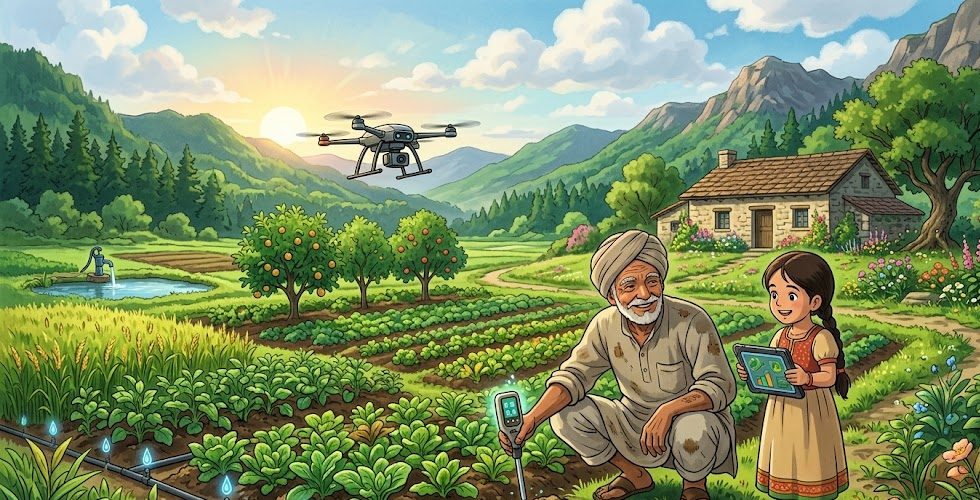
For generations, farming was largely an exercise in intuition. Farmers relied on family traditions, the color of the soil, and the “feel” of the weather to make decisions. While this worked for centuries, it was often inefficient. Today, however, the landscape of agriculture is shifting. We are entering the era of “Precision Agriculture”—a data-driven approach that allows farmers to treat their fields not as a single block of land, but as a collection of unique micro-environments.
A common misconception is that precision agriculture is only for mega-farms with multi-million dollar budgets. This could not be further from the truth. In fact, small-scale farmers often stand to gain the most from these technologies. By implementing affordable, targeted tools, small farmers can save thousands on inputs, minimize waste, and ensure their land remains productive for years to come.
What Is Precision Agriculture?
At its core, precision agriculture is the practice of using data to improve farming efficiency. Instead of applying fertilizer, water, or pesticides uniformly across an entire field—which often results in over-application in some areas and under-application in others—precision tools tell you exactly what each plant needs and where.
For a small farmer, this means transitioning from “blanket” applications to “targeted” management. It is about using the right tool, in the right place, at the right time.
1. Soil Moisture Sensors: Irrigation Mastery
Water is one of the most significant costs for any farmer, and in many regions, it is a scarce resource. Traditional irrigation often follows a fixed schedule, regardless of what the soil actually needs.
The Precision Solution: Affordable soil moisture sensors, which can be connected to your smartphone, provide real-time data on exactly how much water is in the ground.
- The Savings: By watering only when the sensor indicates the soil is drying out, you prevent over-irrigation. This saves money on electricity (if using pumps) and water fees, while preventing root-zone diseases caused by oversaturated soil.
- Resource Management: You stop wasting water on areas that don’t need it, ensuring that this precious resource goes directly to the crop’s roots.
2. Satellite Mapping and Vegetation Indices
You don’t need to own an expensive drone to benefit from aerial insights. Today, numerous mobile apps offer free or low-cost access to satellite imagery that tracks your crop health.
The Precision Solution: Using vegetation indices like NDVI (Normalized Difference Vegetation Index), these apps highlight “stress zones” in your fields. A healthy, dense crop reflects different light than a stressed or diseased one.
- The Savings: If a satellite map shows that only 10% of your field is showing signs of nutrient deficiency, you don’t need to fertilize the whole field. You can spot-treat that specific area. This reduces your expenditure on fertilizer, which is often the highest variable cost for a farm.
- Resource Management: By identifying pest outbreaks or disease early through imagery, you stop problems before they wipe out an entire harvest.
3. Digital Record-Keeping and Analytics
Perhaps the most overlooked tool in a farmer’s arsenal is data analytics. Many small farmers rely on mental notes or scattered notebooks.
The Precision Solution: Simple farm management software allows you to log every expense, planting date, and yield result for every plot of land.
- The Savings: Over a few seasons, this data reveals patterns. You might discover that a certain variety of vegetable performs poorly in your north field but thrives in the south. You stop wasting money planting crops where they aren’t suited to grow.
- Resource Management: Having accurate records makes you eligible for better insurance rates, government subsidies, and loans, as you can prove the efficiency of your operation with clear data.
4. GPS-Assisted Planting and Spraying
Even without a high-tech tractor, GPS tools can help you be more precise. Many farmers are now using simple handheld GPS units or app-based trackers to ensure they aren’t “overlapping” their work.
The Precision Solution: When you are spraying or planting, it is very common to overlap rows. If you overlap by even a few inches on every pass, you are essentially wasting 10–20% of your seeds or chemical inputs.
- The Savings: GPS guidance tools ensure you are traveling in perfectly straight, non-overlapping lines. This “easy” fix can reduce your seed and chemical waste by a double-digit percentage in a single season.
- Resource Management: You minimize soil compaction by reducing the number of passes over the field and ensure that your seeds are spaced optimally for maximum yield potential.
The Path to Implementation: Where to Start?
The biggest mistake small farmers make is trying to adopt all these technologies at once. Precision agriculture is a journey, not a destination.
Step 1: Start with One Problem
Don’t worry about “tech.” Identify the biggest “pain point” on your farm. Is it water usage? Is it excessive spending on fertilizer? Is it inconsistent yields? Pick one problem and find a digital tool that solves that specific issue.
Step 2: Use What You Already Have
You likely already own a smartphone. Your phone is a powerful computer. Start by downloading free agricultural apps, joining community forums for farmers, and exploring free satellite data tools. You don’t need to buy a $50,000 tractor to start farming with precision.
Step 3: Invest in Quality Soil Testing
Data is only as good as the input. Before buying sensors, invest in a thorough soil test from a professional lab. This provides the “baseline” data that makes all your future digital tools more effective.
Frequently Asked Questions (FAQs)
Q: Is precision agriculture too complicated for someone who isn’t tech-savvy? A: Not anymore. Most modern farming apps are designed by companies that understand farmers have busy, hands-on lives. They are built to be intuitive, visually simple, and easy to navigate. If you can use social media or a banking app, you can use a farm management app.
Q: What is the most cost-effective first investment for a small farm? A: Start with soil moisture sensors. They are relatively inexpensive, have a very short learning curve, and provide an immediate, tangible reduction in water usage.
Q: Will this technology replace the need for “boots on the ground” experience? A: Never. Precision tools are decision-support systems. They provide the data, but you provide the wisdom. You still need to walk the field to verify what the data is telling you.
Q: Can these tools help me if I have irregular field shapes? A: Yes. Many mapping and GPS apps are designed to handle odd-shaped plots and can help you optimize your planting routes even in non-rectangular fields.
Conclusion
Precision agriculture is fundamentally about empowerment. For a small farmer, it is the great equalizer. It allows you to compete with larger operations by focusing on efficiency rather than just the scale of your acreage.
By saving money on inputs, reducing the time spent on wasteful tasks, and making data-informed decisions, you aren’t just saving resources—you are building a more sustainable and profitable future for your farm. Remember, small changes in precision lead to big differences in profitability. Start with one sensor, one app, or one record-keeping system this season. Your land, and your bank account, will thank you.