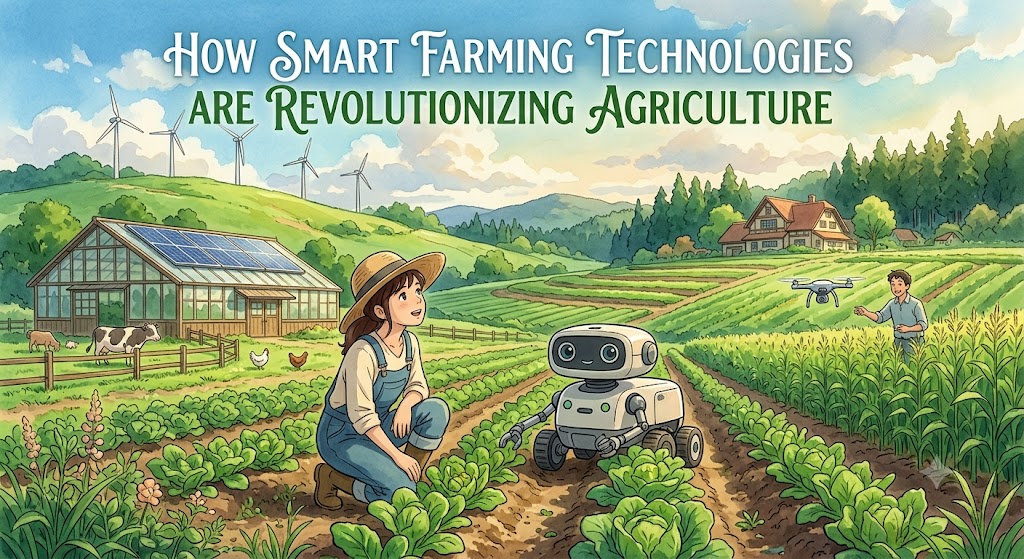
At sunrise, a farmer checks a mobile app before stepping into the field. The app displays soil moisture levels, weather forecasts, crop health reports, and irrigation schedules. A drone has already flown over the farm, identifying areas that need attention, while automated irrigation systems prepare to deliver exactly the amount of water each section requires. Instead of spending hours inspecting every corner of the farm, the farmer already knows where to focus.
Just a decade ago, this level of precision seemed impossible for most agricultural businesses. Today, it is becoming increasingly common as smart farming technologies reshape how food is produced around the world.
Smart farming combines digital tools, connected devices, artificial intelligence, automation, and data analysis to help farmers make faster and more accurate decisions. Rather than replacing traditional farming knowledge, these technologies strengthen it by providing real-time information that improves productivity while reducing waste.
As global agriculture faces rising food demand, climate uncertainty, labor shortages, and increasing production costs, smart farming is becoming one of the most important innovations supporting sustainable food production.
Farming Is Becoming Data-Driven
Traditional farming often depended on observation, personal experience, and seasonal patterns.
While these remain valuable, modern farms now combine experience with measurable data.
Today’s farmers can monitor:
- Soil conditions
- Crop growth
- Weather changes
- Irrigation performance
- Equipment efficiency
- Livestock health
This information helps farmers respond quickly instead of waiting for visible problems.
Smart Sensors Bring Fields to Life
One of the biggest changes in agriculture comes from sensor technology.
Small electronic sensors placed throughout a farm continuously collect information such as:
- Soil moisture
- Soil temperature
- Nutrient availability
- Air humidity
- Water levels
Instead of guessing when crops need water, farmers receive precise information that supports better decisions.
Artificial Intelligence Supports Better Decisions
Artificial Intelligence (AI) is becoming a valuable assistant for modern farmers.
AI systems analyze enormous amounts of agricultural data to identify patterns that humans may overlook.
Examples include:
- Predicting crop diseases
- Estimating harvest times
- Identifying nutrient deficiencies
- Improving irrigation schedules
- Forecasting production risks
These insights help farmers improve efficiency while reducing unnecessary costs.
Drones Are Transforming Crop Monitoring
Walking through large farms to inspect every field can be time-consuming.
Agricultural drones simplify this task by capturing detailed aerial images.
Drones help farmers:
✔ Detect stressed crops
✔ Monitor plant growth
✔ Identify pest damage
✔ Assess irrigation performance
✔ Map field conditions
Regular aerial monitoring allows problems to be addressed before they spread.
Automated Irrigation Saves Water
Water management is becoming increasingly important as climate conditions change.
Smart irrigation systems use data from soil sensors and weather forecasts to deliver water only when needed.
Benefits include:
- Lower water consumption
- Reduced pumping costs
- Healthier crops
- Improved resource efficiency
This approach helps conserve one of agriculture’s most valuable resources.
GPS Technology Improves Precision
Modern farming equipment often uses Global Positioning System (GPS) technology to improve field operations.
GPS supports:
- Accurate planting
- Precise fertilizer application
- Efficient pesticide spraying
- Reduced overlap during field work
Greater precision reduces input waste while improving crop management.
Connected Machinery Increases Efficiency
Agricultural machinery is becoming smarter every year.
Modern equipment can monitor:
- Fuel consumption
- Engine performance
- Working speed
- Field coverage
- Maintenance requirements
Some systems even notify farmers before mechanical problems become serious.
Weather Forecasting Has Become More Accurate
Weather strongly influences agricultural production.
Smart farming platforms combine local weather stations, satellite information, and forecasting models to provide highly detailed weather predictions.
Farmers use these forecasts to plan:
- Planting
- Irrigation
- Fertilizer application
- Harvesting
- Pest management
Better planning reduces weather-related risks.
Smart Livestock Management
Technology is improving livestock farming as well.
Wearable devices and electronic identification systems help monitor:
- Animal movement
- Body temperature
- Feeding behavior
- Reproductive cycles
- Health conditions
Early detection of health problems improves animal welfare while reducing economic losses.
Digital Farm Records Improve Business Decisions
Many successful farms now use digital management software instead of paper notebooks.
Digital records help track:
| Farm Activity | Information Recorded |
|---|---|
| Crop planting | Dates and varieties |
| Irrigation | Water usage |
| Fertilizer application | Quantity and timing |
| Harvests | Yield and quality |
| Equipment | Maintenance history |
| Financial records | Income and expenses |
Organized records support better long-term planning.
Sustainability Through Technology
Smart farming does more than improve production.
It also supports environmental protection by reducing unnecessary resource use.
Major sustainability benefits include:
- Lower water consumption
- Reduced fertilizer waste
- More precise pesticide application
- Lower fuel use
- Improved soil conservation
These improvements benefit both farmers and the environment.
Challenges Farmers Should Consider
Although smart farming offers many advantages, adoption also presents challenges.
Some common concerns include:
- Initial investment costs
- Internet connectivity
- Technical training
- Equipment maintenance
- Data management
Fortunately, many technologies are becoming more affordable and easier to use each year.
Building a Smart Farm Step by Step
Farmers do not need to adopt every technology immediately.
A gradual approach often works best.
Many farms begin by introducing:
- Weather monitoring apps.
- Soil moisture sensors.
- Automated irrigation.
- Drone crop inspections.
- Farm management software.
Expanding gradually reduces costs while allowing farmers to gain practical experience.
The Future of Smart Agriculture
The next generation of farming technologies is already emerging.
Future innovations may include:
- Fully autonomous tractors
- AI-powered robotic harvesting
- Digital crop twins
- Satellite-based farm management
- Blockchain food traceability
- Climate-adaptive farming systems
These technologies will continue transforming agricultural production worldwide.
Final Thoughts
Smart farming technologies are changing agriculture by combining traditional farming knowledge with real-time data, automation, and digital decision-making. Tools such as artificial intelligence, drones, soil sensors, GPS-guided equipment, automated irrigation, and digital management platforms allow farmers to improve productivity while conserving valuable resources.
Although adopting new technology requires planning and investment, the long-term benefits include greater efficiency, lower production costs, improved sustainability, and stronger resilience against climate-related challenges. As these innovations become increasingly accessible, smart farming will continue playing a central role in feeding a growing global population while protecting natural resources for future generations.
Frequently Asked Questions
1. What is smart farming?
Smart farming is the use of digital technologies, sensors, automation, artificial intelligence, and data analysis to improve agricultural productivity and efficiency.
2. How do drones help farmers?
Drones monitor crop health, detect pest and disease problems, assess irrigation performance, and create detailed field maps.
3. Why are soil sensors important?
They measure soil moisture, temperature, and other conditions, helping farmers apply water and nutrients more accurately.
4. Can small farmers use smart farming technologies?
Yes. Many affordable tools, such as weather apps, soil sensors, and automated irrigation systems, are suitable for small and medium-sized farms.
5. How does smart farming support sustainable agriculture?
It reduces water use, minimizes fertilizer and pesticide waste, improves resource efficiency, lowers environmental impact, and helps farmers make more informed decisions.