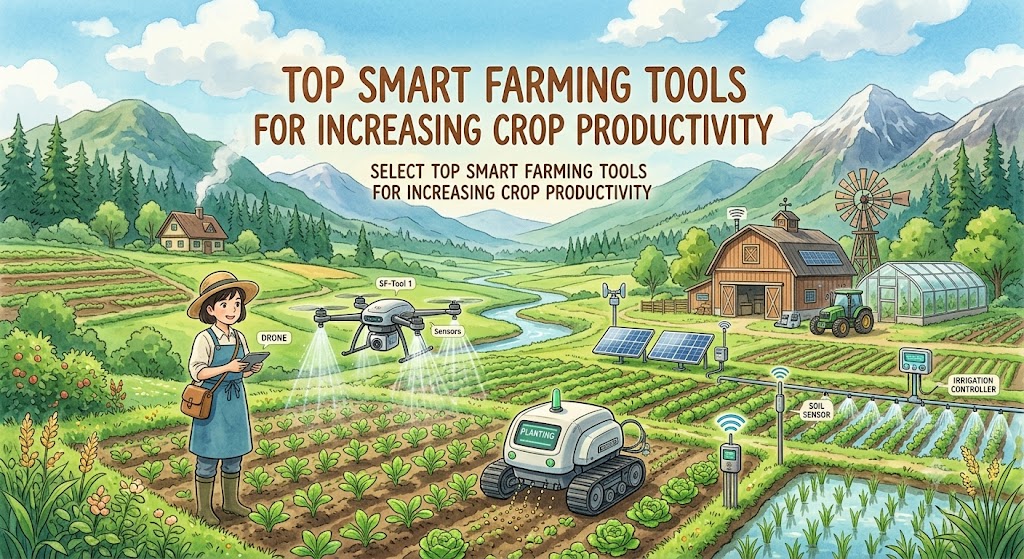
Modern agriculture is no longer driven solely by experience and hard work. While traditional farming knowledge remains valuable, today’s most productive farms also rely on technology to make faster, more accurate decisions. From monitoring soil conditions to automating irrigation and tracking crop health, smart farming tools are helping farmers produce higher yields while using resources more efficiently.
The purpose of these tools is not to replace farmers but to provide better information. When growers understand exactly what their crops need and when they need it, they can reduce unnecessary expenses, improve plant health, and increase overall productivity.
Whether you’re managing a small family farm or a large commercial operation, selecting the right technology can significantly improve farming performance. This guide explores some of the most useful smart farming tools available today and explains how each contributes to better crop production.
Why Smart Farming Tools Matter
Agriculture faces many challenges, including changing weather patterns, rising input costs, labor shortages, and increasing food demand.
Smart farming tools help address these challenges by providing:
- Accurate field information
- Faster decision-making
- Better resource management
- Reduced production waste
- Improved crop monitoring
- Greater operational efficiency
Technology enables farmers to focus their time where it has the greatest impact.
Soil Moisture Sensors
Healthy crops require the right amount of water at the right time.
Soil moisture sensors measure the amount of water available around plant roots and help farmers determine when irrigation is actually needed.
Key Advantages
- Prevents overwatering
- Reduces water waste
- Improves root development
- Supports healthier crops
- Lowers irrigation costs
These sensors are among the easiest smart farming tools to adopt.
Agricultural Drones
Drones have become one of the most valuable technologies in precision agriculture.
Instead of walking across large fields, farmers can inspect crops from the air in just a few minutes.
Drones help monitor:
- Crop health
- Plant growth
- Pest damage
- Disease symptoms
- Water stress
- Field mapping
Early problem detection often prevents significant yield losses.
GPS-Guided Equipment
Modern tractors and farm machinery increasingly use GPS technology to improve field accuracy.
GPS guidance supports:
✔ Straight planting rows
✔ Precise fertilizer application
✔ Efficient pesticide spraying
✔ Reduced overlap
✔ Lower fuel consumption
Greater accuracy improves both productivity and operational efficiency.
Smart Irrigation Controllers
Traditional irrigation schedules often depend on fixed timings.
Smart irrigation systems respond to real field conditions.
They combine information from:
- Soil sensors
- Weather forecasts
- Water availability
- Crop growth stages
This ensures crops receive water only when necessary.
Weather Monitoring Stations
Weather conditions influence nearly every farming activity.
Modern weather stations provide local information about:
- Rainfall
- Temperature
- Humidity
- Wind speed
- Solar radiation
Accurate weather data helps farmers schedule planting, irrigation, spraying, and harvesting more effectively.
Farm Management Software
Keeping accurate records is becoming increasingly important.
Farm management platforms organize information such as:
- Planting schedules
- Input usage
- Labor activities
- Equipment maintenance
- Financial records
- Harvest data
Better records support better business decisions.
Crop Health Imaging Systems
Advanced imaging technologies allow farmers to evaluate crop conditions before visible damage appears.
These systems identify:
- Nutrient deficiencies
- Water stress
- Disease development
- Uneven plant growth
Early identification allows corrective action before problems spread.
Automated Fertigation Systems
Fertigation combines irrigation and fertilizer application into a single process.
Automated systems provide nutrients directly to plant roots according to crop requirements.
Benefits include:
- Precise nutrient delivery
- Reduced fertilizer waste
- Uniform crop growth
- Lower labor requirements
Proper nutrient management contributes directly to higher yields.
Smart Greenhouse Controls
Greenhouse production relies heavily on environmental management.
Smart control systems automatically regulate:
- Temperature
- Humidity
- Ventilation
- Lighting
- Irrigation
Automation creates stable growing conditions throughout the production cycle.
Satellite Crop Monitoring
Satellite technology now provides farmers with regular updates on field performance.
Satellite imagery can help detect:
- Vegetation growth
- Water stress
- Crop uniformity
- Field variability
Large commercial farms especially benefit from this broad field perspective.
Mobile Farming Applications
Smartphones have become valuable agricultural tools.
Modern farming apps assist with:
- Weather forecasts
- Pest identification
- Irrigation planning
- Crop calendars
- Market prices
- Farm record keeping
These applications make agricultural information available anywhere.
Comparing Popular Smart Farming Tools
| Smart Tool | Primary Purpose | Best For |
|---|---|---|
| Soil Moisture Sensors | Irrigation management | All farms |
| Drones | Crop monitoring | Medium and large farms |
| GPS Guidance | Precision field operations | Commercial farms |
| Smart Irrigation | Water efficiency | All farm sizes |
| Weather Stations | Climate monitoring | Crop planning |
| Farm Software | Record management | Farm businesses |
| Crop Imaging | Early crop diagnosis | Precision farming |
| Fertigation Systems | Nutrient management | High-value crops |
| Greenhouse Controls | Environmental management | Protected cultivation |
| Mobile Apps | Daily farm decisions | Every farmer |
Choosing the Right Technology
Not every farm needs every tool.
Selection should depend on:
- Farm size
- Available budget
- Crop type
- Water resources
- Labor availability
- Production goals
Starting with a few practical technologies often provides better results than investing in complex systems immediately.
Mistakes to Avoid
Technology delivers the best results when used correctly.
Avoid these common mistakes:
- Buying equipment without training.
- Ignoring maintenance requirements.
- Collecting data without analyzing it.
- Depending entirely on technology while neglecting field observations.
- Expanding too quickly.
Technology should support farming knowledge, not replace it.
What the Future Looks Like
Smart farming tools continue evolving at a rapid pace.
Future innovations may include:
- AI-powered crop advisors
- Fully autonomous tractors
- Robotic harvesting machines
- Predictive disease detection
- Digital twins for crop management
- Renewable energy-powered farm automation
These technologies will continue improving agricultural productivity while reducing environmental impact.
Final Thoughts
Smart farming tools are transforming modern agriculture by helping farmers make more informed and precise decisions. Technologies such as soil moisture sensors, drones, GPS-guided machinery, smart irrigation controllers, weather stations, farm management software, and crop monitoring systems all contribute to healthier crops, better resource management, and higher productivity.
Rather than viewing technology as a replacement for traditional farming knowledge, successful growers use it as a decision-making partner. By selecting tools that match their farm size, production goals, and budget, farmers can improve efficiency, reduce waste, and build more profitable and sustainable agricultural businesses for the future.
Frequently Asked Questions
1. What is the most useful smart farming tool for beginners?
Soil moisture sensors and mobile farming apps are excellent starting points because they are affordable, easy to use, and improve daily decision-making.
2. How do drones increase crop productivity?
Drones identify crop stress, pest infestations, irrigation issues, and disease symptoms early, allowing farmers to take timely corrective action.
3. Are smart farming tools suitable for small farms?
Yes. Many technologies, including weather apps, soil sensors, and automated irrigation systems, are designed for farms of all sizes.
4. Can smart farming reduce production costs?
Yes. Precision irrigation, accurate fertilizer application, and improved monitoring help reduce unnecessary input costs while improving yields.
5. Should farmers adopt all smart farming technologies at once?
No. It is usually better to begin with a few practical tools, evaluate their benefits, and gradually expand as experience and business needs grow.