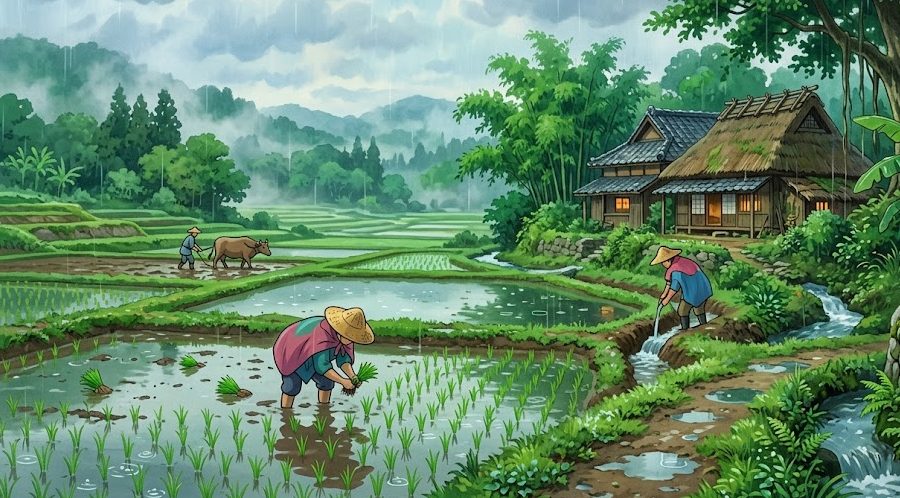
Rain can be one of the most valuable resources on a farm, but heavy or poorly timed rainfall can also create serious challenges. During a wet growing season, farmers must balance water availability with drainage, soil protection, crop timing, disease prevention, and field access.
Rainy-season farming is particularly important in regions where seasonal storms provide a large share of annual precipitation. Across the United States, conditions can vary widely. Some farms may experience long periods of moderate rainfall, while others may deal with intense thunderstorms, saturated soils, flooding, or short periods of heavy precipitation.
Successful wet-season farming begins before the first major rain arrives. Crop selection, field preparation, drainage, soil cover, planting schedules, and equipment planning can all influence how well a farm handles excessive moisture.
Rather than treating rain simply as something that helps crops grow, farmers can manage it as a resource that needs to be captured, distributed, and controlled.
Start With the Seasonal Weather Pattern
The first step in rainy-season farming is understanding the local growing environment.
Farmers should review historical rainfall patterns and local forecasts while considering the timing of the crop’s planting and harvesting periods.
Important questions include:
- When does the wet season normally begin?
- How long do wet conditions typically last?
- Are heavy storms common?
- Does the farm experience temporary flooding?
- How quickly does the soil drain?
- Which fields remain wet the longest?
- When is machinery access most difficult?
Weather history cannot predict every season, but it can help farmers build a more realistic crop calendar.
Current forecasts should then be used to adjust planting, spraying, harvesting, and fieldwork when necessary.
Choose Crops for the Conditions
Not every crop performs equally well under frequent rainfall.
Crop selection should consider soil type, drainage, temperature, disease pressure, market demand, and the expected length of the wet period.
Some crops can tolerate temporary moisture better than others, while certain vegetables and specialty crops may be particularly sensitive to saturated roots.
Farmers should also consider the maturity period.
A crop that takes a long time to mature may face harvesting problems if the wet season continues longer than expected.
A practical crop plan should therefore consider both how a crop grows and when it needs to be harvested.
Divide the Farm Into Moisture Zones
A useful way to plan a rainy-season farm is to stop treating every field as identical.
Different areas may respond differently to the same rainfall.
One field may drain quickly, while another may remain saturated for several days.
Low-lying areas may collect water naturally. Sloped areas may be more vulnerable to erosion. Sandy soils may drain quickly, while heavier soils can retain water for longer.
Mapping these differences can help farmers decide where to plant particular crops.
For example, better-drained areas may be reserved for crops that are sensitive to excess moisture, while more moisture-tolerant crops may be considered for fields that remain wetter.
Prepare the Field Before Heavy Rain Arrives
Field preparation is much easier when the soil is in workable condition.
Working saturated soil with heavy machinery can damage soil structure and create compaction.
Before the rainy period becomes intense, farmers can inspect field entrances, drainage channels, culverts, waterways, and other areas where water normally moves.
Useful preparation may include:
- Clearing blocked drainage paths
- Repairing field drains
- Maintaining grassed waterways
- Stabilizing vulnerable field edges
- Checking culverts
- Protecting exposed soil
- Planning machinery routes
The goal is not to remove every drop of water immediately. Crops need water. The goal is to prevent water from remaining in places where it can damage roots or cause severe erosion.
Improve Drainage Without Wasting Water
Good drainage is one of the most important components of rainy-season farming.
Poor drainage can leave roots without enough oxygen even when the field contains plenty of water.
Surface drainage can sometimes be improved through properly designed channels, waterways, field grading, or other conservation structures.
Subsurface drainage may be appropriate in certain agricultural areas, but it requires careful planning and professional design.
Drainage should also be considered from an environmental perspective.
Moving large amounts of water rapidly off a field can carry soil and nutrients with it.
A better approach is often to slow, filter, store, or safely redirect water where practical.
Protect Soil From Erosion
Heavy rainfall can move significant amounts of soil, particularly on bare or sloping fields.
Once topsoil is lost, rebuilding productive soil can take considerable time.
Keeping the soil covered is therefore an important rainy-season strategy.
Possible methods include:
- Cover crops
- Crop residues
- Mulching
- Grass waterways
- Contour farming where appropriate
- Terraces on suitable terrain
- Vegetated buffer areas
The best erosion-control practice depends on slope, soil type, crop system, and rainfall intensity.
Fields should be inspected after major storms to identify new erosion channels or areas where water is concentrating.
Early repairs can prevent small problems from becoming permanent features.
Avoid Working Saturated Soil
One of the easiest ways to damage a wet field is to enter it with heavy equipment while the soil is saturated.
Machinery traffic can compress soil particles and reduce pore space.
Compacted soil may drain poorly and restrict root development.
The problem can become a cycle:
Heavy rain → saturated soil → machinery traffic → compaction → poorer drainage → longer saturation.
Farmers can reduce this risk by waiting for suitable field conditions whenever possible.
Planning field operations around soil moisture can sometimes prevent much larger problems later in the season.
Plant at the Right Time
Rain can make planting decisions more complicated.
Planting too early into cold, saturated soil can result in poor establishment.
Waiting too long may shorten the crop’s effective growing period.
The ideal planting window depends on the crop, local climate, soil temperature, moisture conditions, and expected weather.
Instead of planting simply because rain has arrived, farmers should evaluate whether the field is actually ready.
A useful field check is to examine whether the soil can support planting equipment without excessive smearing or compaction.
Consider Raised Beds for Suitable Crops
Raised beds can be useful for some vegetable and specialty-crop systems.
They elevate the root zone above the surrounding soil and can improve drainage when properly designed.
Raised beds may be especially useful in smaller production systems where farmers have more control over the growing area.
However, raised beds are not automatically suitable for every crop or soil type.
They can dry out faster during later periods of the season, and heavy rainfall can still create problems if surrounding drainage is poor.
The entire field water system should therefore be considered.
Manage Water Around Vegetable Crops
Vegetable crops can be particularly sensitive to excessive moisture.
Leafy vegetables, root crops, tomatoes, peppers, cucumbers, and other crops each have different water requirements and levels of tolerance.
During periods of frequent rain, irrigation may need to be reduced or stopped temporarily.
Farmers should not irrigate simply because irrigation is part of the normal schedule.
Instead, soil moisture and weather conditions should guide decisions.
Overwatering during an already wet period can increase stress and create unnecessary disease-management challenges.
Watch for Plant Diseases
Warm and wet conditions can create favorable environments for several plant diseases.
Extended leaf wetness and poor airflow can increase disease pressure in some crops.
Farmers should inspect plants regularly for:
- Leaf spots
- Rot
- Wilting
- Unusual discoloration
- Stem problems
- Fruit damage
- Rapid changes in plant appearance
Early identification is important.
Good spacing, proper airflow, field sanitation, resistant varieties where available, and careful irrigation management can all contribute to disease prevention.
Any crop-protection treatment should be selected according to the crop, identified problem, label directions, and applicable local requirements.
Keep Weeds Under Control
Rain can encourage rapid weed growth.
Weeds compete with crops for light, water, nutrients, and growing space.
Wet conditions can also make mechanical weed control difficult because machinery may not be able to enter the field.
This makes early weed planning particularly valuable.
Mulches, cover crops, crop rotation, proper spacing, hand cultivation, mechanical methods, and other integrated approaches can help reduce weed pressure.
The best strategy depends on the crop and production system.
Monitor Nutrient Movement
Heavy rainfall can influence nutrient availability and movement through the soil.
Some nutrients may move deeper into the soil profile, while others can be transported with runoff or erosion.
Applying large amounts of fertilizer immediately before a major storm can therefore be inefficient and potentially harmful to water quality.
Nutrient applications should be based on crop needs, soil-test information, weather conditions, and the expected behavior of the fertilizer.
Good nutrient management becomes especially important when rainfall is frequent.
Create a Rainfall and Soil-Moisture Record
Rainy-season farming becomes easier when farmers have records.
A basic record can include:
- Date of rainfall
- Approximate rainfall amount
- Field condition
- Soil moisture
- Plant growth
- Disease observations
- Drainage problems
- Weed pressure
- Irrigation used
- Crop losses
Over several seasons, these records can reveal patterns.
A farmer may discover that a particular field consistently remains saturated after certain storms, or that a particular planting date performs better under wet conditions.
This information can improve future crop planning.
Use Weather Technology
Modern weather tools can help farmers make better decisions during wet periods.
Farmers can use local weather stations, forecast applications, radar information, soil-moisture sensors, and farm-management platforms to monitor changing conditions.
Technology can help answer practical questions such as:
- Is another storm expected?
- How much rain has already fallen?
- Is the soil likely to remain saturated?
- Should irrigation be delayed?
- Is harvesting likely to be interrupted?
- When might field conditions improve?
Technology should support field observations rather than completely replace them.
A sensor provides useful information, but the farmer still needs to understand what that information means for the crop.
Plan Harvesting Before the Wettest Period
Harvest timing can become one of the biggest challenges during a rainy season.
A crop may be ready for harvest just as fields become too wet for machinery.
Farmers should consider the likely harvest window when selecting planting dates and crop varieties.
Where practical, growers can also plan:
- Alternative field access routes
- Equipment availability
- Temporary storage
- Labor requirements
- Drying capacity
- Transportation
- Market delivery schedules
Harvest losses can be expensive, so post-harvest planning should be part of the original crop plan.
Protect Stored Crops
Rainy weather does not stop being a problem after crops leave the field.
High humidity can affect stored agricultural products if storage areas are not properly managed.
Storage buildings should be checked for:
- Roof leaks
- Poor ventilation
- Water entry
- Condensation
- Damaged doors or seals
- Inadequate drainage
Crops should be stored according to their specific moisture and temperature requirements.
Good storage management protects the value of the work already completed in the field.
What to Do After a Heavy Storm
After major rainfall, farmers should inspect the farm systematically.
Start with water movement.
Look for:
- Standing water
- New erosion channels
- Damaged drainage structures
- Exposed roots
- Washed-out soil
- Damaged roads
- Broken fences
- Crop lodging
- Sediment deposits
Avoid rushing heavy equipment into saturated areas.
Some damage may appear minor immediately after a storm but become more serious later.
Documenting damage with photographs and field notes can also help with future planning and, where applicable, agricultural assistance or insurance documentation.
Building a Rain-Ready Farm
A farm does not need to wait for a major storm to improve its resilience.
A simple long-term strategy can include:
Protect the soil. Keep vulnerable fields covered and reduce unnecessary disturbance.
Improve drainage. Maintain safe paths for excess water.
Plan crop placement. Match crops to field conditions.
Monitor moisture. Avoid adding irrigation when rainfall has already provided enough water.
Maintain access. Keep farm roads, entrances, and drainage structures in usable condition.
Prepare equipment. Inspect machinery before critical planting and harvesting periods.
Keep records. Track rainfall, soil conditions, crop performance, and losses.
These practices can make wet-season management more predictable.
Common Rainy-Season Mistakes
Several problems can be avoided through better planning.
One common mistake is assuming that more water always means better crop growth.
Another is entering wet fields too early with heavy machinery.
Other mistakes include:
- Planting without considering drainage
- Ignoring low-lying areas
- Applying unnecessary irrigation
- Leaving bare soil exposed
- Delaying erosion repairs
- Applying fertilizer immediately before major storms
- Ignoring early signs of plant disease
- Failing to plan harvest access
- Neglecting storage conditions
Rain can be beneficial, but unmanaged water can quickly become a production problem.
A Practical Seasonal Checklist
Before the rainy period:
- Review expected weather patterns
- Select suitable crops
- Inspect drainage
- Repair field access
- Protect vulnerable soil
- Check equipment
During the wet season:
- Monitor soil moisture
- Watch crop health
- Inspect drainage
- Delay unnecessary field traffic
- Adjust irrigation
- Monitor weeds and diseases
- Record rainfall and field conditions
After major storms:
- Inspect erosion
- Check drainage structures
- Assess crop damage
- Photograph problem areas
- Repair critical infrastructure
- Update future field plans
Final Thoughts
Rainy-season farming requires farmers to think beyond simply providing enough water for crops. The real challenge is managing water at the right time, in the right place, and at the right amount.
Good crop selection, careful planting schedules, protected soil, reliable drainage, moisture monitoring, and thoughtful field operations can help farms handle wet conditions more effectively.
The best rainy-season strategy will always depend on local climate, soil type, terrain, crops, and farm resources. What works on a well-drained field in one part of the United States may not be appropriate for a low-lying field in another region.
The most effective approach is to prepare before heavy rain arrives, observe conditions throughout the season, and use each growing cycle as an opportunity to improve the next one.
With good planning, rainfall does not have to be viewed only as a farming risk. It can become a valuable resource that supports crop production while careful field management protects the land for future seasons.