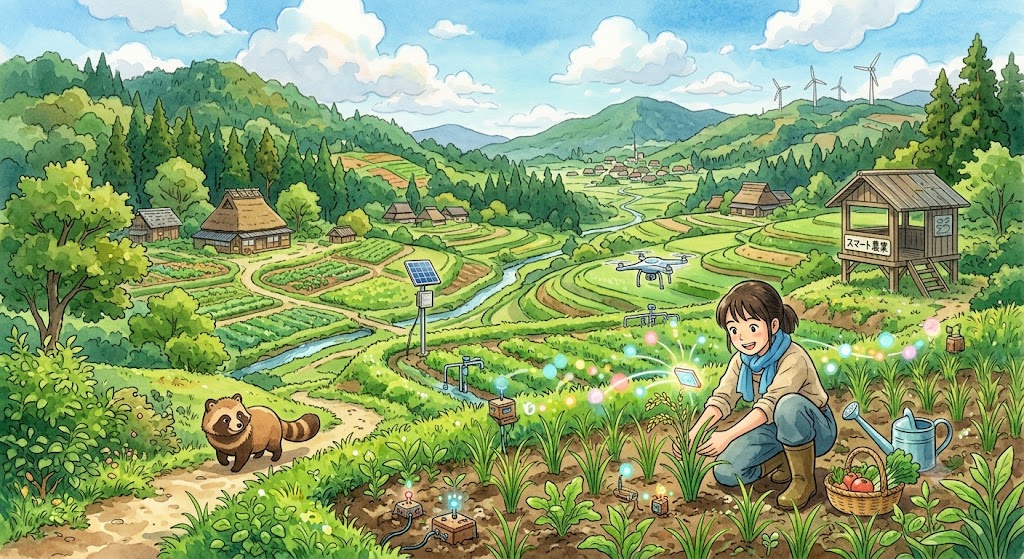
Modern agriculture is becoming increasingly connected. Farmers can now collect information about soil moisture, weather, crop conditions, machinery activity, irrigation, and field performance and use that information to make more informed decisions.
This approach is often described as smart farming.
Smart farming does not mean replacing farmers with machines. Instead, it combines agricultural experience with digital tools that can help farmers understand what is happening in their fields and respond more efficiently.
For farms across the United States, smart farming can be useful in many different production environments. A row-crop operation in the Midwest may use GPS guidance and yield mapping, while a vegetable farm in California may focus on irrigation sensors and field monitoring. A greenhouse operation may depend on automated temperature and humidity controls.
The technology available today ranges from relatively simple sensors to advanced automated systems. The most successful approach is usually to choose technology based on a specific farm problem rather than purchasing equipment simply because it is new.
What Makes a Farm “Smart”?
A smart farm uses information to improve everyday decisions.
The basic process can be viewed as a continuous cycle:
Observe → Collect → Analyze → Decide → Act → Measure
A farmer first collects information through field observations, sensors, machinery, weather data, satellite imagery, or other tools.
That information is then analyzed to identify patterns or problems.
The farmer makes a decision and takes action.
Finally, the result is measured so future decisions can improve.
This process is important because data alone does not improve a farm. Data becomes valuable when it leads to a better decision.
Start With a Specific Farm Problem
One of the biggest mistakes in agricultural technology is starting with equipment instead of a problem.
Before purchasing a sensor or automation system, farmers should ask:
- What problem am I trying to solve?
- How often does the problem occur?
- What information would help me make a better decision?
- How much does the problem currently cost?
- Can the technology realistically improve the situation?
For example, if a farm regularly over-irrigates certain fields, soil-moisture sensors may be useful.
If machinery frequently overlaps during field operations, GPS guidance may provide greater value.
If crop problems are difficult to identify across large fields, aerial imagery may be worth considering.
The technology should serve the farm rather than become another source of unnecessary complexity.
Soil Sensors for Better Field Decisions
Soil conditions can vary considerably within the same field.
One part of a field may hold more water, while another area may dry quickly. Nutrient levels, temperature, compaction, and other characteristics can also differ.
Soil sensors can provide information that is difficult to obtain through occasional manual checks.
Depending on the system, sensors may monitor:
- Soil moisture
- Soil temperature
- Electrical conductivity
- Other soil characteristics
Moisture sensors are particularly useful for irrigation management.
Instead of irrigating according to a fixed schedule, farmers can use actual soil conditions to decide when irrigation is necessary.
This can reduce unnecessary water use while helping crops avoid prolonged dry conditions.
Weather Stations on the Farm
Weather can influence nearly every agricultural decision.
A farm weather station can collect information such as temperature, humidity, rainfall, wind speed, and other environmental conditions.
Having weather information directly from the farm can be more useful than relying only on a weather report from a distant location.
Farm-level weather data can support decisions related to:
- Irrigation
- Planting
- Spraying
- Disease monitoring
- Frost protection
- Harvest timing
- Field access
Historical weather records can also become valuable over time.
After several seasons, farmers may be able to compare crop performance with local temperature and rainfall patterns.
Smart Irrigation Systems
Irrigation is one of the areas where automation can provide immediate practical benefits.
Traditional irrigation schedules may operate according to fixed days or time periods.
Smart irrigation systems can combine soil-moisture information, weather conditions, crop requirements, and irrigation schedules to determine when water should be applied.
A basic automated system may use:
- A soil sensor
- A controller
- Irrigation valves
- A pump or water source
- A programmed decision rule
More advanced systems can integrate weather forecasts and multiple sensor locations.
The objective is not necessarily to irrigate more frequently. The objective is to apply water when it is actually needed.
GPS and Precision Field Operations
GPS technology has become an important part of modern agriculture.
GPS-guided machinery can help farmers maintain accurate field paths during planting, fertilizing, spraying, and harvesting.
This can reduce overlap and make field operations more consistent.
GPS guidance can be especially valuable for large fields where even small overlaps can represent significant amounts of wasted seed, fertilizer, chemicals, fuel, and time.
Some systems also support automated steering, allowing machinery to follow predefined paths with limited operator correction.
The farmer remains responsible for monitoring the operation and making appropriate decisions.
Field Mapping and Digital Farm Records
A farm map can contain much more information than field boundaries.
Digital mapping systems can record:
- Soil zones
- Crop history
- Yield
- Irrigation infrastructure
- Drainage
- Fertilizer applications
- Pest observations
- Field boundaries
- Machinery activity
Over time, these records create a digital history of the farm.
This history can help farmers understand why certain areas consistently perform better or worse than others.
Instead of treating the entire field as one uniform area, farmers can begin managing it according to its actual characteristics.
Satellite and Aerial Monitoring
Large farms can be difficult to inspect completely on foot.
Satellite imagery can provide regular visual information about crop development across broad areas.
Drones can offer more detailed images over smaller areas.
These tools can help identify areas that appear different from the surrounding crop.
Possible causes may include:
- Water stress
- Nutrient problems
- Pest activity
- Disease
- Poor establishment
- Drainage issues
- Machinery damage
Imagery does not always identify the exact cause of a problem.
A farmer should use the image as a signal to investigate the field rather than treating it as a final diagnosis.
Using Sensors to Improve Crop Monitoring
Crop monitoring sensors can provide information about conditions that may change throughout the growing season.
Depending on the technology, sensors can measure environmental or plant-related characteristics.
For example, greenhouse growers can monitor temperature, humidity, light levels, and carbon dioxide.
Outdoor growers may combine soil sensors, weather stations, satellite imagery, and field observations.
The more sensors a farm uses, the more important organization becomes.
Too much information can become difficult to interpret.
A good system focuses attention on measurements that actually influence decisions.
Automation in Greenhouses
Controlled-environment agriculture is one of the areas where automation can be particularly powerful.
Greenhouse systems can automatically adjust certain environmental conditions using sensors and controllers.
Depending on the facility, automation may manage:
- Ventilation
- Fans
- Heating
- Cooling
- Irrigation
- Fertigation
- Lighting
- Humidity
- Shade systems
For example, a temperature sensor can trigger ventilation equipment when the greenhouse becomes too warm.
A moisture-based irrigation controller can activate irrigation when growing media becomes sufficiently dry.
Automation can reduce repetitive labor, but systems still require inspection and maintenance.
Automated Fertigation
Fertigation combines irrigation and fertilizer delivery.
In controlled systems, automated equipment can deliver nutrient solutions through irrigation lines according to programmed settings.
This can improve consistency when properly designed and monitored.
However, automated fertilizer delivery does not eliminate the need for crop knowledge.
Farmers still need to understand crop requirements, water quality, nutrient concentrations, equipment calibration, and changing crop conditions.
Automation can repeat a mistake just as efficiently as it can repeat a good decision.
Artificial Intelligence in Agriculture
Artificial intelligence is increasingly being incorporated into agricultural technology.
AI systems can analyze large amounts of information and identify patterns that may be difficult to detect manually.
Potential applications include:
- Crop image analysis
- Weed identification
- Yield prediction
- Weather analysis
- Irrigation recommendations
- Pest monitoring
- Equipment diagnostics
- Field classification
Computer vision systems, for example, may examine images to distinguish crops from weeds.
AI can also help organize large datasets collected from sensors and farm-management platforms.
However, AI recommendations should be treated as decision-support information.
Field conditions can change quickly, and farmers still need to verify important recommendations against real-world observations.
Smart Machinery
Modern farm machinery can collect and exchange large amounts of operational information.
Tractors and harvesting equipment may record information about:
- Fuel consumption
- Field location
- Operating speed
- Engine performance
- Implement activity
- Harvest yield
- Machine hours
This information can help identify inefficient field operations.
For example, if a particular operation consistently takes longer or consumes more fuel than expected, the farmer can investigate whether equipment setup, field conditions, operator practices, or maintenance are responsible.
Predictive maintenance can also help identify equipment issues before a major breakdown occurs.
Yield Mapping
Yield maps show how crop production varies across a field.
During harvest, suitable equipment can record yield information along with GPS coordinates.
After the season, the farmer can compare yield maps with soil information, fertilizer applications, irrigation, weather, and previous crop history.
This can reveal patterns that may otherwise remain hidden.
For example, consistently lower yields in one section may suggest drainage problems, soil limitations, compaction, or another field-specific issue.
Yield mapping becomes much more valuable when it is combined with other farm information.
Smart Weed and Pest Management
Technology can make pest and weed management more targeted.
Camera-based systems can identify differences between crop plants and unwanted vegetation.
Drones and satellite imagery can help locate areas that require closer inspection.
Field sensors and digital scouting tools can help farmers record pest observations by location.
Instead of treating every part of a field exactly the same, growers can potentially focus attention where the problem actually exists.
This approach can reduce unnecessary applications and make field scouting more efficient.
Connecting Farm Data
A smart farm can generate information from many different sources.
The challenge is bringing that information together.
A farm-management platform may combine:
- Weather data
- Soil measurements
- GPS information
- Crop records
- Input applications
- Machinery information
- Yield data
- Financial records
When information is organized in one place, farmers can more easily compare production decisions with outcomes.
For example, a farmer may compare irrigation levels with yield results or fertilizer applications with crop performance.
Data Security and Reliability
Farm data is becoming an important agricultural asset.
Connected equipment and cloud-based software can contain information about fields, production, machinery, input usage, and business operations.
Farmers should understand how their data is stored, who can access it, and whether information can be exported if they change software providers.
Technology should also be protected against basic operational problems.
Backup procedures, secure accounts, software updates, and reliable internet or offline functionality can become important considerations.
A smart farm should still have a plan for what happens if a sensor, controller, internet connection, or automated system stops working.
Smart Farming for Small Farms
Advanced technology is not limited to large agricultural operations.
Small farms can start with relatively simple tools.
A practical entry point might be:
- One weather station
- A few soil-moisture sensors
- Digital field records
- GPS mapping
- Automated irrigation
- Mobile crop-scouting tools
The goal is not to create a fully automated farm immediately.
Small improvements can be tested on one field or crop before being expanded.
This reduces financial risk and allows farmers to learn how the technology fits their existing workflow.
Calculating the Value of Technology
Smart farming equipment should be evaluated like any other farm investment.
Farmers should consider:
Purchase cost + installation + maintenance + subscriptions + training + replacement costs
against potential benefits such as:
Input savings + labor savings + reduced crop losses + improved productivity + better decision-making.
A sensor that costs relatively little but saves significant irrigation expenses may be a good investment.
A complicated system that provides information nobody uses may not provide much value.
Return on investment should therefore be considered before expanding a technology program.
A Practical Smart Farming Roadmap
Farmers can introduce smart technology gradually.
First: Identify the biggest inefficiency
Look for excessive water use, fuel consumption, labor requirements, input waste, or inconsistent crop performance.
Next: Collect basic information
Use field records, measurements, and observations to understand the problem.
Then: Test one technology
Choose a tool that directly addresses the identified issue.
Measure the result
Compare costs, labor, crop performance, and resource use before and after implementation.
Expand carefully
If the technology produces measurable value, introduce it to additional fields or operations.
This approach prevents technology spending from getting ahead of actual farm needs.
Common Smart Farming Mistakes
Technology can create new problems when it is poorly planned.
Common mistakes include:
- Buying equipment without a clear purpose
- Installing sensors without maintaining them
- Collecting more data than the farm can use
- Ignoring calibration
- Depending completely on automated systems
- Failing to train workers
- Not backing up important records
- Ignoring equipment compatibility
- Expanding before testing
- Focusing on technology instead of farm economics
The smartest farm is not necessarily the one with the most devices.
It is the farm that uses useful information to make better decisions.
What the Future May Look Like
Agricultural technology will likely become increasingly connected.
Sensors, autonomous machinery, artificial intelligence, satellite imagery, robotics, weather systems, and farm-management software are gradually becoming part of the same digital ecosystem.
Future systems may allow farmers to monitor entire operations from centralized dashboards and receive alerts when field conditions change.
Robotic equipment may perform more repetitive tasks, while AI systems may help interpret increasingly large datasets.
Even as technology develops, agricultural knowledge will remain essential.
Machines can collect information, but farmers still need to understand crops, soil, weather, markets, and the practical realities of operating a farm.
Final Thoughts
Smart farming provides farmers with new ways to understand and manage their operations.
Sensors can reveal soil and environmental conditions. Weather stations can improve planning. GPS can make machinery operations more precise. Satellite imagery and drones can help identify field problems. Automation can reduce repetitive work, while artificial intelligence can help interpret large amounts of information.
The key is to use these technologies with a clear purpose.
A successful smart-farming system should make the farm easier to manage, improve resource efficiency, reduce avoidable losses, or support better crop decisions.
Farmers do not need to automate everything at once. Starting with one meaningful problem, testing a suitable technology, measuring the result, and expanding gradually is often the most practical path.
When agricultural experience and modern data work together, smart farming can become more than a collection of gadgets. It can become a structured way to make better decisions, use resources more efficiently, and build a more productive and resilient farm.