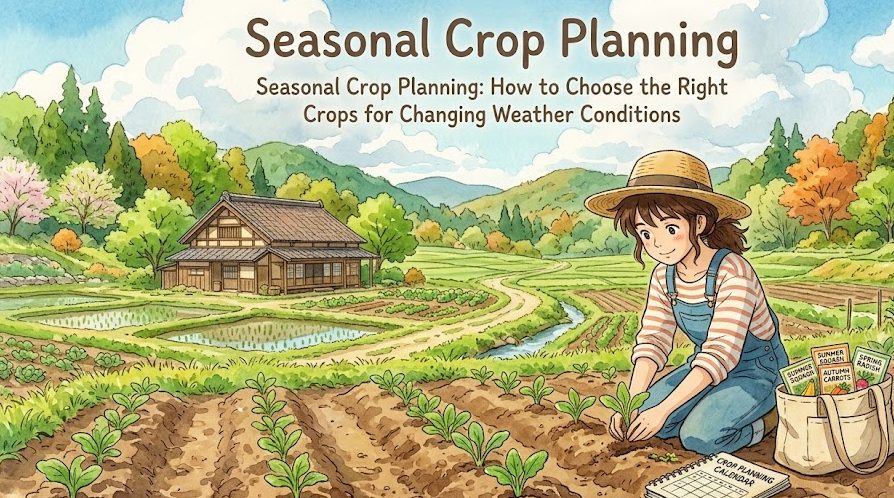
Successful farming begins long before seeds are placed in the soil. One of the most important decisions a grower makes is choosing which crops to plant, when to plant them, and how much of each crop to grow. Weather conditions can change significantly throughout the year, and a crop that performs well during one season may struggle when temperatures, rainfall, daylight, or soil conditions shift.
Seasonal crop planning helps farmers match crop choices with the conditions they are most likely to encounter. Instead of following a fixed planting calendar every year, growers can build a flexible plan based on local climate patterns, soil conditions, water availability, market demand, and expected weather.
For farms across the United States, this approach is particularly useful because growing conditions vary widely. A crop calendar that works in Florida may not work in Minnesota, while the planting strategy used in California may be completely different from one used in Pennsylvania.
The goal of seasonal planning is not to predict the weather perfectly. It is to create a farming system that can adapt when conditions are warmer, colder, wetter, drier, or more unpredictable than expected.
Start With the Local Growing Environment
Before selecting crops, farmers should understand the environment in which those crops will grow.
Several factors influence crop performance:
- Temperature
- Frost risk
- Rainfall
- Soil type
- Daylight hours
- Growing-season length
- Water availability
- Wind exposure
- Drainage
- Local pest pressure
USDA plant hardiness zones can be useful for understanding temperature patterns, particularly when planning perennial plants, but they are only one part of crop planning. Annual vegetable and field crops also depend heavily on soil temperature, frost dates, rainfall, and the length of the active growing season.
A farm should therefore have its own practical climate record whenever possible.
Keeping track of planting dates, unusual weather, frost events, rainfall, crop performance, and harvest timing can provide information that becomes more useful every year.
Think in Seasons Rather Than One Long Growing Cycle
A farm can be divided into several seasonal production windows instead of treating the year as a single growing period.
For example, a simplified plan might include:
Early spring: cool-season crops and soil preparation
Late spring: transition toward warm-season crops
Summer: heat-loving vegetables and field crops
Fall: cool-season crops and winter preparation
Winter: protected production, overwintering crops, soil protection, maintenance, and planning
The exact timing depends on the region.
This seasonal approach allows farmers to use the same land more efficiently while reducing the risk of planting a crop at the wrong time.
Match Crops With Temperature
Temperature is one of the strongest factors affecting crop growth.
Cool-season crops generally perform better during mild temperatures and can include crops such as:
- Spinach
- Lettuce
- Kale
- Peas
- Radishes
- Broccoli
- Cabbage
- Carrots
- Turnips
Warm-season crops generally require warmer soil and air temperatures. Examples include:
- Tomatoes
- Peppers
- Cucumbers
- Squash
- Beans
- Melons
- Sweet corn
The important point is that a crop’s season should be considered from planting through harvest.
For example, a farmer might have warm enough conditions to plant a crop but not enough time remaining in the season for that crop to reach maturity before the next major weather change.
Use Growing Degree Information
Farmers can improve crop planning by paying attention to the relationship between temperature and crop development.
Many crops progress through their growth stages based partly on accumulated temperature rather than calendar dates alone. This is why a crop may mature earlier during a warm season and later during a cooler season.
Growing degree days, often called GDDs, are one method farmers and agricultural professionals use to estimate crop development.
Instead of saying that a crop will always mature exactly 70 days after planting, a grower can consider the temperatures experienced during that period.
This can make crop planning more flexible when weather patterns change.
Consider Soil Conditions Before Planting
Weather and soil conditions are closely connected.
Heavy spring rainfall can delay fieldwork, while dry conditions can make seed establishment difficult. Cold, saturated soil may also slow germination and increase the risk of poor plant establishment.
Before planting, farmers should evaluate:
- Soil moisture
- Soil temperature
- Drainage
- Compaction
- Soil structure
- Nutrient status
- pH
- Residue and organic matter
A field may be technically within the recommended planting calendar but still not be ready for planting.
Waiting for workable soil conditions can sometimes be better than rushing into the field and creating compaction or poor seed placement.
Build a Crop List for Each Season
Instead of choosing crops one at a time, create a seasonal crop list.
A simple planning table can include:
| Season | Crop | Preferred Conditions | Approximate Harvest Window | Weather Risk |
|---|---|---|---|---|
| Spring | Lettuce | Cool, moderate conditions | Spring | Heat |
| Spring | Peas | Cool conditions | Late spring | Heat |
| Summer | Tomatoes | Warm conditions | Summer | Extreme heat |
| Summer | Cucumbers | Warm conditions | Summer | Drought |
| Fall | Kale | Cool conditions | Fall/Winter | Severe cold |
The exact crops and timing should be adjusted to the local farm.
This type of planning makes it easier to identify gaps in production and avoid putting too much land into crops with the same weather risks.
Plan Around Frost
Frost is a major consideration for many U.S. farms.
A late spring freeze can damage newly planted warm-season crops, while an early fall freeze can shorten the harvest period.
Farmers should know their area’s historical frost patterns and monitor short-term forecasts during sensitive periods.
For crops that are vulnerable to frost, possible strategies include:
- Waiting longer before planting
- Starting plants indoors
- Using transplants
- Selecting earlier-maturing varieties
- Using row covers
- Growing under tunnels
- Using frost protection when appropriate
- Maintaining flexibility in planting dates
The objective is not to eliminate all frost risk. Instead, farmers can reduce exposure by planning around the most vulnerable growth stages.
Don’t Ignore Rainfall Patterns
Rainfall can change the suitability of a crop just as much as temperature.
A crop that performs well in moderate moisture may struggle during an unusually wet season. Another crop may suffer if rainfall remains below normal.
When planning crops, consider whether the farm has:
- Reliable irrigation
- Good natural drainage
- Water storage
- Drought-tolerant options
- Moisture-retaining soil
- Fields with different water conditions
It can also be useful to divide fields according to their water characteristics.
A low-lying area that holds moisture may be suitable for different crops than a well-drained field located on higher ground.
Prepare for Unusual Weather
Modern crop planning should include some flexibility because actual weather rarely follows a perfect seasonal script.
A farmer might experience:
- An unusually warm spring
- A late freeze
- Heavy rainfall
- A prolonged dry period
- Extreme summer heat
- Early fall frost
- Strong winds
- Unexpected temperature swings
Instead of creating only one crop plan, consider creating a primary plan and a backup plan.
For example, if planting is delayed by wet weather, an earlier-maturing variety or another suitable crop may be used instead.
This flexibility can prevent a single weather event from disrupting the entire production schedule.
Choose Varieties, Not Just Crops
Selecting the right crop is only half the decision.
Variety selection can have a major impact on performance.
Two varieties of the same vegetable may differ in:
- Days to maturity
- Temperature tolerance
- Disease resistance
- Drought response
- Plant size
- Yield characteristics
- Harvest period
- Storage quality
When possible, farmers should compare varieties based on local performance rather than choosing solely because a variety is popular elsewhere.
Seed companies, local extension resources, experienced growers, and farm records can help narrow down suitable choices.
Use Succession Planting
Succession planting can spread production across a longer period.
Instead of planting an entire field or garden on one day, farmers can make several plantings at planned intervals.
This can help:
- Extend the harvest period
- Reduce the impact of one bad weather event
- Avoid having all crops mature simultaneously
- Provide a steadier supply for customers
- Improve labor organization
For crops with relatively short maturity periods, succession planting can be especially useful.
However, each planting should still be matched with the expected weather conditions for that part of the season.
Diversify Weather Risk
Crop diversity is not only about having more products to sell. It can also help distribute environmental risk.
Imagine a farm growing only one crop. If that crop is highly sensitive to a particular weather event, the entire farm may be affected.
A diversified plan could include crops with different:
- Planting dates
- Temperature preferences
- Root systems
- Harvest periods
- Water requirements
- Weather tolerances
For example, a farm might combine a cool-season vegetable, a warm-season vegetable, a root crop, and a longer-season crop.
Diversification does not guarantee success, but it can reduce dependence on one production window.
Consider Market Timing Too
Weather should not be the only factor in seasonal crop planning.
Farmers also need to know when customers are likely to want a crop.
Market opportunities may include:
- Farmers markets
- Grocery stores
- Restaurants
- Community-supported agriculture programs
- Farm stands
- Wholesale buyers
- Local food businesses
A crop can perform very well in the field but still create challenges if the farmer does not have a clear market for the harvest.
The strongest crop plan balances growing conditions with selling opportunities.
Use Protected Growing Systems When Appropriate
Greenhouses, high tunnels, low tunnels, and other protected structures can expand the range of crops that farmers can grow during difficult weather periods.
Protected systems can help with:
- Frost protection
- Wind reduction
- Rain management
- Earlier planting
- Later harvesting
- Temperature management
They also require active management.
Ventilation, irrigation, humidity, crop spacing, pests, and temperature can become important concerns inside a protected structure.
Farmers should therefore calculate whether the additional production opportunity justifies the investment and management requirements.
Keep a Weather and Crop Performance Journal
One of the most valuable crop-planning tools is often a simple farm record.
For every season, record:
- Planting date
- Variety
- Weather conditions
- Rainfall
- Irrigation
- Frost events
- Pest problems
- Disease observations
- Harvest date
- Yield
- Crop quality
- Labor requirements
- Major losses
- Selling price or market performance
After several seasons, these records can reveal patterns.
A farmer may discover that one crop consistently performs better when planted slightly earlier, while another crop struggles during periods of excessive rainfall.
This information can gradually make seasonal planning more accurate.
A Practical Seasonal Planning Method
A simple planning process can look like this:
Step 1 — Review the climate:
Look at historical temperature, rainfall, frost, and growing-season patterns.
Step 2 — Identify your production window:
Determine when your soil and weather conditions are likely to support planting.
Step 3 — List suitable crops:
Choose crops that fit the temperature, moisture, and available growing period.
Step 4 — Select varieties:
Compare maturity times and environmental characteristics.
Step 5 — Check the market:
Identify when and where each crop could be sold.
Step 6 — Create a backup plan:
Prepare alternatives for delayed planting, extreme weather, or crop failure.
Step 7 — Stagger production:
Use succession planting when appropriate.
Step 8 — Record results:
Track what happened so next year’s plan can improve.
This process does not require complicated software. A spreadsheet or farm notebook can be enough for a small operation.
Technology Can Improve Seasonal Decisions
Technology can make crop planning more precise.
Farmers may use:
- Digital weather forecasts
- Local weather stations
- Soil moisture sensors
- Soil temperature sensors
- Satellite imagery
- Crop-management software
- GPS field mapping
- Irrigation monitoring systems
- Farm record applications
These tools can help farmers see changing conditions faster and make decisions based on actual field information.
However, technology should support practical observation rather than replace it. Walking fields and examining crops remains an important part of good farm management.
Final Thoughts
Seasonal crop planning is essentially a process of matching the right crop with the right conditions at the right time.
Weather will always contain some uncertainty, but farmers can reduce unnecessary risk by understanding their local climate, preparing soil carefully, selecting suitable varieties, monitoring moisture and temperature, diversifying crops, and maintaining flexible planting schedules.
The best seasonal plan is not necessarily the most complicated one. It is a plan that fits the farm’s land, resources, labor, water supply, market opportunities, and realistic weather conditions.
By recording what happens each season and using those observations to improve future decisions, farmers can gradually build a more resilient and productive cropping system—one season at a time.