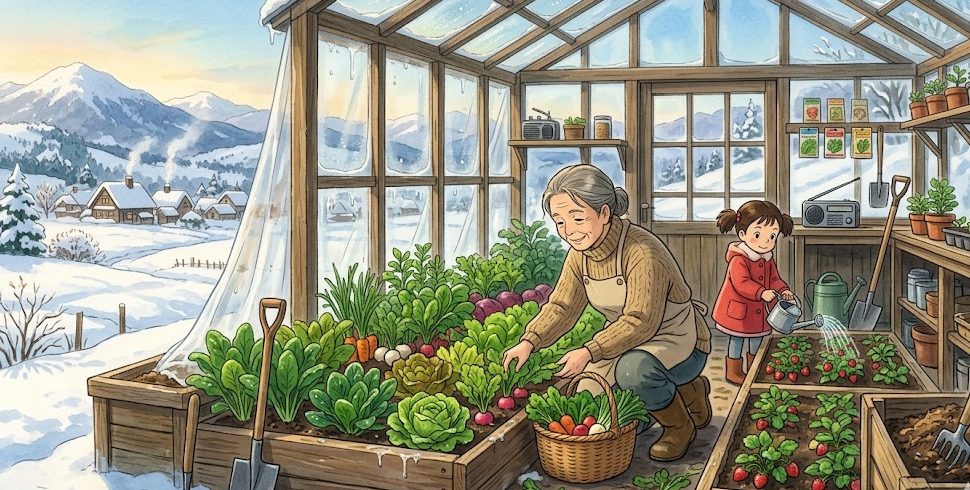
When the winter frost sets in, many farmers and homesteaders hang up their tools and wait out the cold. But leaving your soil dormant for three to four months of the year means leaving a massive amount of revenue and fresh produce on the table.
Winter farming does not require expensive, high-tech commercial glasshouses fitted with industrial gas heaters. With a few simple, low-cost greenhouse techniques, you can easily trick nature into creating a warm, thriving microclimate.
Whether you are looking to protect fragile winter crops or get a massive head start on your spring seedlings, this ultimate guide will show you exactly how to maximize your winter greenhouse yields without breaking the bank.
The Core Secret of Low-Cost Winter Farming: Thermal Mass
In an unheated winter greenhouse, the biggest threat to your crops isn’t actually the daytime cold; it is the sudden, freezing drop in temperature at midnight. To maximize your yields naturally, you need to understand the concept of Thermal Mass.
Thermal mass refers to any material that can absorb heat from the sun during the bright daylight hours and slowly release that stored warmth back into the air when the temperature drops at night.
The Water Barrel Technique
One of the simplest, cheapest, and most effective ways to introduce thermal mass into a backyard greenhouse is by using 55-gallon drums filled with water.
- Paint the metal or plastic barrels matte black to maximize heat absorption.
- Stack them along the north wall of your greenhouse where they will catch the direct winter sunlight all day long.
- During the day, the water absorbs solar energy. At night, as the greenhouse cools down, the barrels act like gentle, radiant radiators, keeping the internal ambient temperature several degrees above freezing.
1. Implementing the “Double Insulation” Method
Think of a standard plastic greenhouse as a windbreaker jacket. It stops the cold breeze, but it doesn’t offer much insulation. To keep your winter yields high, you need to add an extra layer of protection—similar to wearing a sweater under your jacket.
Inside-the-Greenhouse Low Tunnels
Instead of trying to insulate the entire volume of your greenhouse, focus entirely on insulating the specific garden beds where your plants live. You can do this by constructing miniature low tunnels right over your rows inside the main structure.
- Use flexible PVC pipes or heavy wire hoops to create a frame over your growing beds.
- Drape a lightweight, breathable agribon fabric (floating row cover) over the hoops.
- This simple “greenhouse-within-a-greenhouse” setup traps a secondary pocket of stagnant air right around the plants, preventing frost from settling on the leaves and boosting the internal temperature by an additional 4°C to 6°C.
2. Choosing the Best High-Yield Winter Varieties
No matter how well you insulate a simple greenhouse, you cannot grow tropical tomatoes or peppers in the dead of winter without expensive artificial heating. Maximizing your yield depends entirely on working with biology, not against it.
Focus your winter greenhouse real estate on ultra-hardy, frost-tolerant cool-season crops that actually thrive when daytime temperatures are low.
- Premium Leafy Greens: Spinach, Kale, Swiss Chard, and Arugula. Spinach is particularly incredible for winter farming because its sugar content rises in the cold as a natural defense mechanism, making winter-harvested spinach incredibly sweet.
- Crisp Root Vegetables: Carrots, Radishes, and Turnips. Winter carrots grown in a protected greenhouse develop an exceptional flavor and remain perfectly crisp.
- Alliums and Herbs: Scallions (green onions), Garlic Chives, and Cilantro can withstand heavy cold snaps easily inside a plastic structure.
Quick Reference: Winter Greenhouse Crop Management
To help you organize your planting schedule, here is a quick breakdown of how top winter crops perform in a simple greenhouse setup:
| Crop Variety | Frost Tolerance | Growth Rate in Winter | Best Planting Window | Yield Potential |
| Spinach | Outstanding (Survives hard freezes) | Moderate | Late Autumn | Extremely High (Multiple cuts) |
| Kale | Excellent (Flavor improves with frost) | Steady | Mid-Autumn | High (Continuous harvest) |
| Carrots | High (Top green leaves may wilt, roots stay safe) | Slow | Early Autumn | High (Single harvest, high market value) |
| Radishes | Moderate to High | Fast (Ready in 30-40 days) | Rolling winter cycles | Excellent for quick cash flow |
3. Managing the Winter Moisture Trap
The fastest way to kill a promising winter crop isn’t actually the cold—it is muck and mold. Because the air inside a winter greenhouse is cool and enclosed, water evaporates very slowly from the soil surface. This creates a high-humidity environment that is a breeding ground for destructive fungal diseases like gray mold (Botrytis) or damp-off.
Change Your Watering Schedule
- Never water your greenhouse plants in the evening. Any water droplets left sitting on the leaves overnight will freeze or invite fungal spores to germinate.
- Only water your crops on bright, sunny mornings around 10:00 AM. This gives the soil surface a few hours to warm up and allows excess moisture on the plant foliage to evaporate before nightfall.
- Water directly at the base of the plants rather than using overhead watering cans.
Don’t Skip Ventilation
Even if it is freezing outside, you must open the doors or vents of your greenhouse for a brief 15-to-30-minute window during the warmest part of a sunny day. This flushes out stagnant, humid air and introduces fresh carbon dioxide ($CO_2$), which your plants need to stay strong and healthy.
4. Maximizing Vertical Space and Light Reflection
Winter days are short, and the angle of the sun is incredibly low. To get the absolute maximum yield out of your space, you need to capture and utilize every single photon of light that hits your property.
Keep the Plastic Spotless
Over the summer and autumn, dust, pollen, and algae build up on your greenhouse plastic. This grime can block up to 20% of incoming solar light. Before the deep winter starts, take a soft brush, mild soap, and water to thoroughly wash down the exterior of your greenhouse. Clean plastic means more light, more heat, and faster plant growth.
Use Reflective Northern Backdrops
Since the sun travels low along the southern sky (in the Northern Hemisphere), the north wall of your greenhouse receives almost no direct sunlight.
- Cover the interior of your greenhouse’s north wall with a reflective material, such as a cheap silver emergency space blanket or white plastic sheeting.
- This bounces the incoming southern sunlight back onto the rear rows of your crops, preventing them from stretching and growing leggy toward the light.
Final Thoughts: The Year-Round Harvest
Maximizing your winter farming yields doesn’t require a massive financial investment or high-tech automated machinery. By simply harnessing the natural laws of thermal mass, adding simple low-tunnel layers inside your structure, selecting the right cold-hardy greens, and carefully controlling moisture, you can successfully turn your greenhouse into a highly productive oasis in the middle of a blizzard.
Winter farming keeps your cash flow steady, protects your soil biology from freezing solid, and ensures that you always have fresh, nutrient-dense food on your table when the rest of the world is waiting for spring.