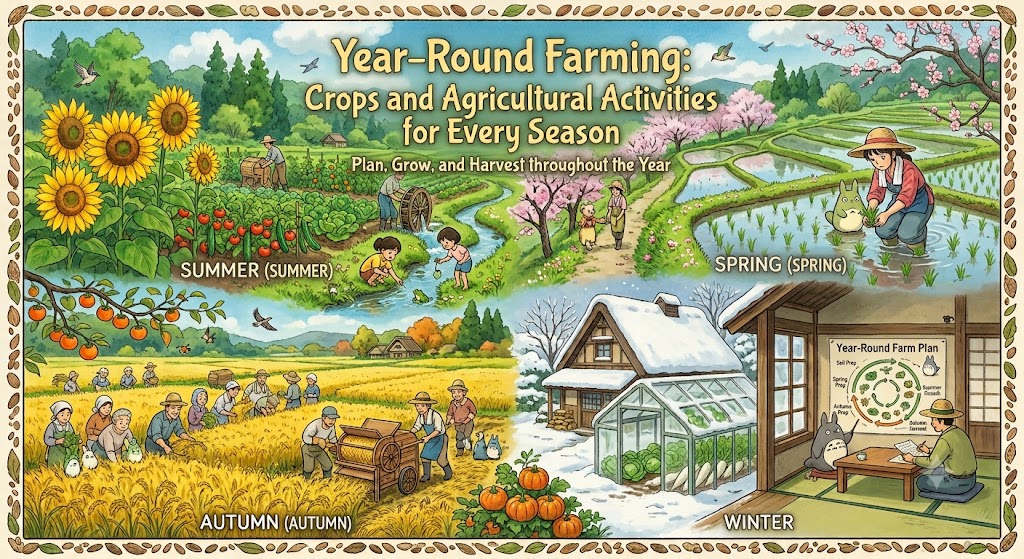
Running a farm throughout the year requires more than simply planting a crop when the weather looks suitable. Successful year-round farming depends on coordinating crops, soil preparation, irrigation, labor, machinery, pest management, harvesting, storage, and marketing across different seasons.
Every season brings its own opportunities and challenges. Spring may be an important period for planting and field preparation. Summer can increase water demand and heat stress. Rainy periods may require stronger drainage and disease monitoring. Winter can bring cooler temperatures and slower plant growth.
A year-round farm plan connects these seasonal activities into one continuous system.
The goal is not to keep every field occupied at all times. Instead, farmers should use land and resources intelligently, maintain soil health, reduce idle periods where practical, and make sure that each crop fits within the farm’s available water, labor, equipment, and market opportunities.
Start With the Whole Year, Not Just One Crop
Many farm decisions are connected.
The crop harvested today may influence what can be planted next.
The amount of residue left after harvest can affect soil preparation.
A crop’s irrigation demand may compete with another crop for available water.
Harvesting dates can determine labor requirements.
For this reason, farmers should create an annual overview before focusing on individual planting dates.
A simple yearly plan can include:
- Crops planned for each field
- Planting windows
- Expected harvest periods
- Irrigation requirements
- Fertilizer schedules
- Pest-monitoring periods
- Labor requirements
- Machinery needs
- Storage requirements
- Expected market periods
The plan should remain flexible because actual weather and market conditions may require adjustments.
Divide the Farm Into Management Zones
Not every field behaves the same way.
One area may have heavier soil and retain moisture longer. Another may drain quickly. Some fields may have better access to irrigation, while others may depend more heavily on rainfall.
Dividing the farm into practical management zones can make planning easier.
Farmers can consider soil type, drainage, slope, water availability, crop history, and previous yields.
This allows different fields to receive management suited to their actual conditions.
A year-round plan becomes more realistic when it recognizes these differences instead of treating the entire farm as one uniform area.
Spring: Prepare, Plant, and Establish
In regions with a spring growing season, this period can be used for preparing the farm for active production.
Before planting, farmers should inspect soil conditions, irrigation equipment, drainage, tools, and machinery.
Seed quality should also be checked.
Planting should take place when soil and weather conditions are appropriate for the selected crop.
Focus on Strong Crop Establishment
The early stages of crop growth can influence later performance.
Farmers should monitor germination, seedling development, weeds, soil moisture, and early pest activity.
Avoiding unnecessary disturbance during establishment can help young plants develop stronger root systems.
Where appropriate, mulching or other soil-cover practices can help protect moisture and reduce weed competition.
Spring is also a useful period for identifying problems before they become expensive.
Summer: Manage Heat and Water
Summer can place greater pressure on farm resources.
Higher temperatures can increase evaporation and crop water requirements.
Farmers should review irrigation schedules rather than automatically following the same routine used during cooler months.
Soil moisture monitoring can help determine when irrigation is actually needed.
Drip irrigation or other efficient systems may be useful for suitable crops.
Protect Crops From Heat Stress
Summer crop management may include:
Maintaining soil cover
Controlling weeds
Improving irrigation efficiency
Monitoring heat-sensitive growth stages
Checking for pest increases
Planning work during safer hours
The goal is to keep crops productive without wasting water.
Rainy Season: Manage Excess Water
Where the year includes a significant rainy period, the farm’s priorities can change quickly.
Instead of focusing mainly on supplying water, farmers may need to focus on controlling excess moisture.
Blocked drains can cause standing water.
Heavy rainfall can increase erosion.
High humidity can create favorable conditions for some diseases.
Inspect Drainage Before Major Rainfall
Drainage channels should be checked for sediment, weeds, debris, and other blockages.
Low-lying fields should be monitored after heavy rainfall.
Farmers should also avoid unnecessary machinery movement across saturated soil because wet soil can be vulnerable to compaction.
Protect Soil During Heavy Rain
Suitable crop residues, cover crops, vegetation, and erosion-control practices can help protect soil from rainfall impact.
The exact approach depends on the farm’s soil and landscape.
Autumn: Transition and Prepare
Autumn can be an important transition period in many farming systems.
Some summer crops may be approaching harvest while cool-season crops need to be planned.
Farmers can use this period to review field performance and prepare for the next production cycle.
Crop rotation decisions should be made with both soil health and market demand in mind.
Plan the Next Crop Before Harvest Ends
Waiting until one crop is completely finished before thinking about the next can create unnecessary delays.
Farmers should already know:
- Which field will receive the next crop
- What seed is required
- Whether soil preparation is necessary
- How much irrigation will be available
- When labor will be needed
- What the expected market is
Advance preparation keeps the farm moving efficiently.
Winter: Grow Cool-Season Crops and Maintain the Farm
Winter can be productive for suitable crops.
Leafy vegetables, certain grains, legumes, and other cool-season crops may perform well when temperatures are appropriate.
However, frost and cold conditions can affect sensitive crops.
Farmers should select varieties suitable for their local winter environment.
Use Winter for Maintenance
Winter can also provide an opportunity to repair and prepare farm infrastructure.
Farmers can inspect:
Tractors
Irrigation pumps
Drip lines
Storage buildings
Tools
Greenhouses
Fencing
Drainage systems
Equipment maintenance during lower-demand periods can reduce delays during busy seasons.
Plan Crop Rotation Across the Year
Crop rotation is one of the most useful ways to connect seasons.
Instead of planting the same crop repeatedly in the same field, farmers can rotate crops with different characteristics.
A rotation may include cereals, legumes, vegetables, oilseeds, or other suitable crops depending on local conditions.
Different crops can have different rooting patterns and nutrient demands.
Rotation can also help diversify farm production and disrupt some pest and disease cycles.
The specific rotation should be designed around local soil conditions, climate, crop biology, and market demand.
Keep Soil Working Without Exhausting It
Year-round production can put continuous pressure on soil.
If every season is focused only on maximum production, soil structure and fertility may gradually become more difficult to maintain.
Farmers should include soil-building practices where appropriate.
These may include:
- Cover crops
- Crop residues
- Organic amendments
- Suitable crop rotations
- Reduced unnecessary soil disturbance
- Erosion-control measures
Soil should be viewed as a long-term production asset.
Protecting it today can support future harvests.
Build a Twelve-Month Water Plan
Water requirements can change significantly throughout the year.
A farm may need less irrigation during rainy periods and considerably more during hot, dry months.
Farmers should estimate seasonal water demand and compare it with available supplies.
This can reveal potential shortages before they occur.
Efficient irrigation systems should be inspected regularly.
Leaks and blocked lines should be repaired quickly.
Water should be prioritized for crops and growth stages where it provides the greatest value.
Schedule Fertilizer Around Crop Needs
Fertilizer planning should also follow the annual crop calendar.
Applying nutrients without considering soil conditions, crop growth stage, and weather can lead to unnecessary expense.
Soil testing can help identify nutrient requirements.
Farmers should also consider nutrients already supplied through crop residues, organic materials, or previous applications.
The objective is not to use more fertilizer.
It is to provide the right nutrients in appropriate amounts when crops can use them effectively.
Plan Pest Management Throughout the Year
Pest pressure does not necessarily follow a simple calendar.
Weather, crop growth, surrounding vegetation, and previous crops can all influence pest populations.
Farmers should monitor fields regularly throughout the year.
Early scouting can identify developing problems before they become severe.
Integrated pest management can combine:
Field monitoring
Crop rotation
Resistant varieties where available
Biological controls
Physical methods
Cultural practices
Targeted chemical control when necessary
Crop-protection products should always be used according to their labels and applicable regulations.
Coordinate Labor With Crop Cycles
Labor requirements can change dramatically during the year.
Planting, weeding, pruning, harvesting, sorting, and packing may each create periods of high demand.
Farmers should identify these periods in advance.
If several crops reach harvest at the same time, labor shortages can lead to quality losses.
Staggering planting dates where suitable can spread labor requirements.
The same principle can apply to harvesting and market deliveries.
Use Machinery Efficiently
Machinery should be included in the annual plan.
Farmers can identify when tractors, harvesters, tillage equipment, sprayers, and other machines will be required.
Preventive maintenance can be scheduled during periods of lower use.
Planning machinery movement can also reduce unnecessary field trips and fuel consumption.
If two suitable operations can be combined, farmers may sometimes reduce time and fuel use.
However, field conditions should always take priority over rigid schedules.
Plan Harvesting Before Crops Mature
Harvesting should never be treated as an afterthought.
Farmers should estimate expected harvest windows and arrange labor, equipment, storage, packaging, transportation, and buyers in advance.
This becomes particularly important for perishable crops.
A crop can lose quality quickly if harvesting is delayed because workers or transport are unavailable.
Good annual planning connects production directly to post-harvest management.
Reduce Losses After Harvest
Growing a successful crop is only part of farming.
Food can be lost during:
- Harvesting
- Sorting
- Cleaning
- Packing
- Transportation
- Storage
- Marketing
Farmers can reduce losses through careful handling, suitable containers, proper storage conditions, and efficient transportation.
The appropriate method depends on the crop.
Post-harvest planning should therefore begin before the crop reaches maturity.
Keep the Farm Connected to the Market
A year-round farm should not produce simply because land is available.
Market demand matters.
Farmers should investigate when buyers want particular crops, what quality standards they expect, and what prices are realistic.
Diversifying planting dates can sometimes help spread sales across different periods.
Direct sales, local markets, wholesalers, retailers, processors, and other buyers may have different requirements.
Understanding those requirements can improve production planning.
Keep Financial Records Across Seasons
A yearly plan should include financial information.
Track:
Seed costs
Fertilizer
Crop protection
Irrigation
Fuel
Labor
Machinery maintenance
Storage
Packaging
Transportation
Sales revenue
At the end of each season, compare costs with returns.
A crop that produces a large harvest is not necessarily the most profitable if its production costs are extremely high.
Financial records help farmers identify where resources are creating the greatest value.
Use Technology Where It Makes Sense
Modern technology can connect different parts of the annual farm plan.
Farmers may use digital records, weather applications, GPS tools, soil-moisture sensors, automated irrigation, satellite imagery, or farm-management software.
The technology should solve a practical problem.
For example, moisture sensors may help with irrigation decisions.
Digital records can simplify seasonal comparisons.
Weather alerts can support preparation for extreme conditions.
Technology works best when it complements agricultural knowledge rather than replacing it.
Build Flexibility Into the Plan
A year-round plan should never be completely rigid.
Weather can delay planting.
Rain can interrupt harvesting.
A pest outbreak can require a management change.
Market prices can shift.
Equipment can fail.
Farmers should therefore create alternative options where practical.
For example, if planting is delayed, know which alternative crop or later planting window may be possible.
If water becomes limited, identify which fields should receive priority.
If harvesting is delayed by rain, have a backup labor or transportation plan.
Flexibility makes the annual plan much more useful.
Review Every Season Before Moving Forward
The end of each season is the beginning of the next planning cycle.
Farmers should review:
Yield
Input costs
Water use
Pest problems
Weather damage
Labor requirements
Harvest losses
Market performance
Soil condition
The purpose is not simply to record what went wrong.
Farmers should also identify what worked particularly well.
A successful practice can then be repeated or expanded.
A Simple Year-Round Farm Planning Model
A practical annual system can be organized into six stages:
1. Plan
Choose crops, estimate resources, and identify planting windows.
2. Prepare
Get soil, equipment, seeds, irrigation, and labor ready.
3. Plant
Establish crops under suitable conditions.
4. Manage
Monitor water, nutrients, weeds, pests, diseases, and weather.
5. Harvest
Coordinate maturity, labor, equipment, storage, and buyers.
6. Review
Measure results and use the information to improve the next cycle.
Then the process begins again.
Think of the Farm as One Continuous System
The biggest advantage of year-round planning is that farmers stop treating each season as an isolated event.
Spring decisions influence summer.
Summer management affects autumn soil conditions.
Rainy-season practices can influence winter planting.
Winter maintenance can prepare the farm for the next spring.
Everything is connected.
This approach can also reduce periods of unnecessary inactivity while protecting resources that need time to recover.
Create a Farm Calendar That Can Change
A useful farm calendar should contain both fixed and flexible activities.
Fixed activities may include equipment maintenance, scheduled market deliveries, or known planting windows.
Flexible activities can include irrigation, harvesting, field preparation, and pest management depending on weather and crop conditions.
Farmers can review the calendar weekly and make adjustments when necessary.
This is more practical than creating an annual schedule and never updating it.
The Value of Small Improvements
Year-round farming does not require farmers to completely redesign their operations.
Small improvements can accumulate.
Better irrigation scheduling can save water.
More careful harvesting can reduce losses.
Crop rotation can improve field planning.
Regular machinery maintenance can reduce downtime.
Accurate records can reveal unnecessary expenses.
Improved timing can make better use of labor.
When these improvements are repeated across several seasons, they can significantly influence overall farm efficiency.
Creating a Farm That Works All Year
Year-round farming is ultimately about coordination.
Farmers need to think beyond individual crops and consider how land, water, soil, labor, machinery, weather, and markets interact throughout the year.
A good annual plan begins with understanding local seasons and available resources.
From there, farmers can select suitable crops, organize rotations, prepare fields, manage irrigation, protect soil, monitor pests, schedule labor, plan harvesting, and review financial results.
The plan should always remain flexible because farming takes place in a changing environment.
Turning Every Season Into Part of the Plan
Every season has a different role.
One period may be ideal for planting.
Another may require intensive irrigation.
A rainy period may make drainage the priority.
Cooler months may provide excellent conditions for specific crops.
The important thing is to connect these periods rather than manage them independently.
Farmers who plan across the full year can make better use of available land and resources while reducing avoidable delays and waste.
The strongest year-round farming systems are not built around doing more work every month.
They are built around doing the right work at the right time, protecting the resources that support production, learning from every season, and preparing for the next one before it arrives.