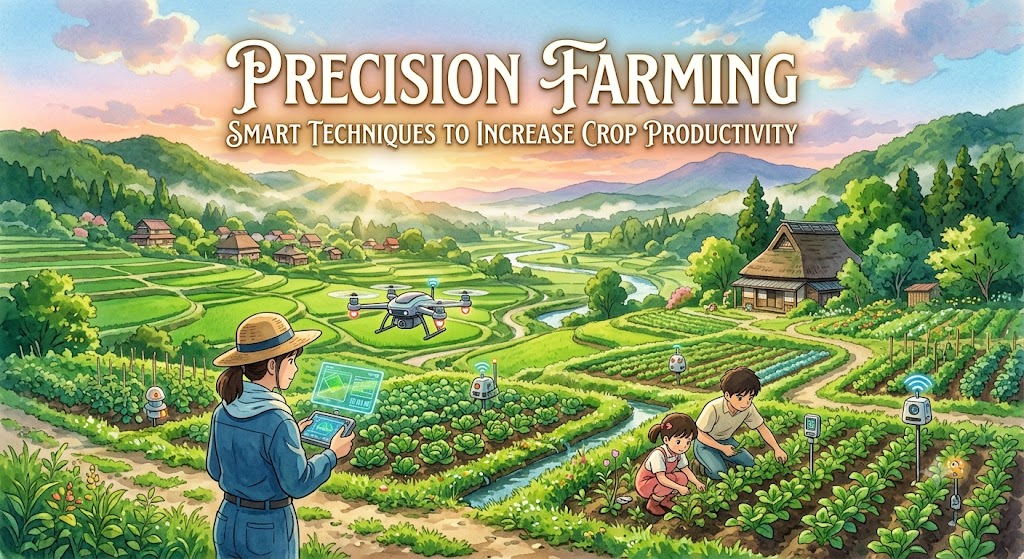
Modern agriculture is undergoing a major transformation as farmers adopt advanced technologies to produce more food while using fewer resources. Rising production costs, changing weather patterns, labor shortages, and increasing demand for high-quality crops have made efficiency more important than ever. Precision farming has emerged as one of the most effective approaches to achieving these goals by helping farmers manage their fields with greater accuracy and control.
Unlike traditional farming, where an entire field is often treated the same way, precision farming recognizes that different areas of a field may have different soil conditions, moisture levels, nutrient requirements, and crop performance. By collecting and analyzing data, farmers can apply water, fertilizers, pesticides, and other inputs only where they are needed. This targeted approach improves crop productivity, reduces waste, and supports sustainable farming practices.
Whether you own a small family farm or a large commercial operation, precision farming offers practical solutions that can increase yields while protecting natural resources.
What Is Precision Farming?
Precision farming, also known as precision agriculture or site-specific crop management, is a modern farming system that uses technology, data, and careful field analysis to improve crop production. Instead of making decisions based only on observation or experience, farmers use real-time information from sensors, satellites, drones, GPS devices, weather stations, and farm management software.
This data helps farmers understand exactly what each part of the field needs, allowing them to make better decisions regarding irrigation, fertilization, pest control, planting, and harvesting.
The primary goals of precision farming include:
- Increasing crop yields
- Improving input efficiency
- Conserving water
- Reducing fertilizer waste
- Lowering production costs
- Protecting soil health
- Supporting sustainable agriculture
Why Precision Farming Is Important
Every field contains natural variation. Soil fertility, moisture, organic matter, and drainage are rarely uniform across an entire farm.
Traditional farming often treats all areas equally, which may result in:
- Over-fertilization in some areas
- Under-fertilization in others
- Excess irrigation
- Uneven crop growth
- Higher production costs
Precision farming solves these problems by applying resources according to the actual needs of each section of the field.
This approach improves efficiency while maximizing returns on investment.
1. GPS-Guided Field Operations
Global Positioning System (GPS) technology is one of the foundations of precision agriculture.
GPS-guided tractors and machinery improve accuracy during field operations.
Benefits include:
- Straight planting rows
- Reduced overlaps
- Better seed placement
- Accurate fertilizer application
- Efficient pesticide spraying
- Lower fuel consumption
Even small improvements in accuracy can produce significant savings over large farming areas.
2. Soil Testing and Mapping
Healthy soil is essential for productive farming.
Precision farming begins with understanding soil conditions across the field.
Soil testing measures:
- pH
- Organic matter
- Nitrogen
- Phosphorus
- Potassium
- Micronutrients
Field mapping identifies areas with different nutrient levels and productivity.
Instead of applying the same fertilizer everywhere, farmers can adjust nutrient applications based on actual soil conditions.
This improves nutrient efficiency while reducing unnecessary expenses.
3. Variable Rate Technology (VRT)
Variable Rate Technology allows equipment to automatically adjust the amount of fertilizer, seed, or crop protection products applied in different areas of a field.
For example:
Areas with lower fertility may receive additional nutrients.
Highly fertile areas receive only the amount required.
This technology improves resource efficiency while reducing environmental pollution.
VRT also helps improve crop uniformity throughout the field.
4. Soil Moisture Monitoring
Water management is one of the most important factors influencing crop productivity.
Soil moisture sensors continuously measure water levels near plant roots.
Benefits include:
- Reduced overwatering
- Improved irrigation timing
- Better root development
- Lower pumping costs
- Increased water conservation
Farmers irrigate only when crops actually require water.
This approach improves both yields and sustainability.
5. Smart Irrigation Systems
Traditional irrigation schedules often waste water.
Smart irrigation systems automatically adjust watering based on:
- Soil moisture
- Weather forecasts
- Temperature
- Humidity
- Crop growth stage
These automated systems deliver water more efficiently while preventing water stress.
Healthy crops require consistent moisture rather than excessive irrigation.
6. Agricultural Drones
Drones have become valuable tools for crop monitoring.
Equipped with high-resolution cameras and specialized sensors, drones provide detailed aerial images of farmland.
They help identify:
- Nutrient deficiencies
- Pest infestations
- Disease outbreaks
- Water stress
- Poor drainage
- Weed growth
Farmers can inspect large fields quickly without walking through every section.
Early problem detection prevents small issues from becoming major crop losses.
7. Satellite Imaging
Satellite technology allows farmers to monitor crop performance over large areas.
Satellite images reveal differences in:
- Vegetation growth
- Soil moisture
- Plant health
- Crop stress
- Field variability
Regular monitoring supports timely management decisions throughout the growing season.
Satellite information is especially valuable for large commercial farms.
8. Artificial Intelligence
Artificial Intelligence (AI) analyzes agricultural data and provides recommendations for farm management.
AI can assist with:
- Yield prediction
- Disease diagnosis
- Pest identification
- Irrigation scheduling
- Fertilizer planning
- Harvest timing
Machine learning systems continue improving as more farm data becomes available.
This allows increasingly accurate decision-making.
9. Internet of Things (IoT)
The Internet of Things connects farm equipment and monitoring devices through the internet.
Connected devices include:
- Soil sensors
- Weather stations
- Irrigation controllers
- Livestock trackers
- Water tanks
Farmers receive real-time updates on smartphones or computers.
Quick access to accurate information allows faster responses to changing field conditions.
10. Weather Monitoring
Weather greatly influences farming success.
On-farm weather stations provide information about:
- Rainfall
- Temperature
- Humidity
- Wind speed
- Solar radiation
Farmers use this data when planning:
- Planting
- Irrigation
- Fertilizer applications
- Crop protection
- Harvesting
Accurate weather information reduces unnecessary risks.
11. Precision Pest and Disease Management
Instead of spraying pesticides across entire fields, precision farming allows farmers to identify specific problem areas.
Using drones, sensors, AI, and field scouting, farmers can detect pest outbreaks early.
Targeted treatment:
- Reduces pesticide use
- Protects beneficial insects
- Lowers production costs
- Improves environmental sustainability
Early intervention also improves crop quality.
12. Farm Management Software
Digital farm management systems organize important agricultural information.
Farmers can record:
- Crop varieties
- Planting dates
- Irrigation schedules
- Fertilizer applications
- Pest observations
- Harvest data
- Machinery maintenance
- Financial records
Well-organized data supports better planning and long-term decision-making.
Benefits of Precision Farming
Precision agriculture provides numerous advantages.
Major benefits include:
- Higher crop yields
- Better fertilizer efficiency
- Improved water conservation
- Lower pesticide use
- Reduced fuel consumption
- Lower labor costs
- Improved crop quality
- Better soil health
- Increased farm profitability
- Greater environmental sustainability
The combination of these improvements strengthens long-term farm performance.
Challenges of Precision Farming
Although precision agriculture offers many benefits, farmers may face certain challenges.
These include:
- Initial investment costs
- Technical training
- Internet connectivity
- Equipment maintenance
- Data management
- Technology compatibility
However, technology continues becoming more affordable, making precision farming increasingly accessible.
Many farmers begin with basic soil testing, GPS mapping, or smart irrigation before adopting more advanced systems.
Tips for Successfully Adopting Precision Farming
Farmers interested in precision agriculture should focus on gradual implementation.
Recommended steps include:
- Conduct regular soil testing.
- Install soil moisture sensors.
- Use GPS-enabled field mapping.
- Monitor weather forecasts daily.
- Keep digital farm records.
- Evaluate crop performance regularly.
- Upgrade equipment gradually.
- Learn from agricultural extension programs and training workshops.
Successful precision farming depends on accurate data and consistent management rather than expensive equipment alone.
Frequently Asked Questions
What is precision farming?
Precision farming is a modern agricultural approach that uses technology and field data to manage crops more accurately, improving productivity while reducing waste.
Can small farmers use precision farming?
Yes. Many affordable tools such as soil testing, GPS-enabled smartphones, weather apps, moisture sensors, and farm management software are suitable for small farms.
How do drones improve crop productivity?
Drones detect crop stress, nutrient deficiencies, diseases, weeds, and irrigation problems early, allowing farmers to take timely corrective action.
Does precision farming reduce fertilizer use?
Yes. By applying nutrients only where needed, farmers reduce waste while maintaining or improving crop yields.
Is precision farming environmentally friendly?
Absolutely. Precision farming conserves water, reduces chemical use, improves nutrient efficiency, protects soil health, and minimizes environmental pollution.
Conclusion
Precision farming is revolutionizing modern agriculture by enabling farmers to make smarter, data-driven decisions that improve productivity and sustainability. Technologies such as GPS-guided machinery, soil testing, variable rate technology, drones, satellite imagery, artificial intelligence, IoT sensors, smart irrigation systems, and farm management software help optimize every stage of crop production. These innovations allow farmers to use resources more efficiently, reduce operational costs, improve crop quality, and increase yields while protecting valuable natural resources.
Although adopting precision farming may require investment and training, the long-term benefits far outweigh the challenges. Farmers who embrace these smart techniques can strengthen the resilience of their operations, respond more effectively to changing environmental conditions, and build a more profitable and sustainable future. As agriculture continues to evolve, precision farming will remain one of the most powerful tools for meeting global food demands while ensuring responsible resource management.