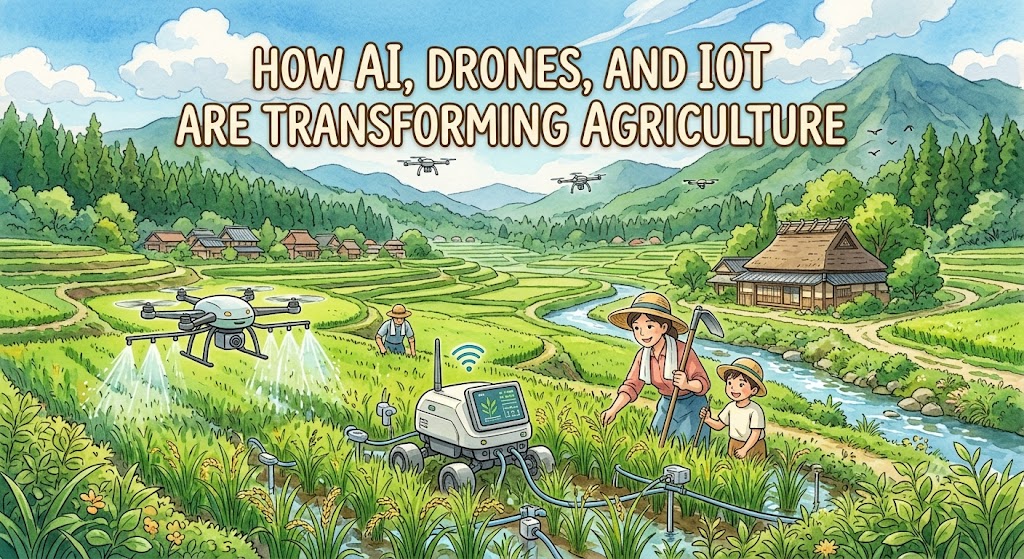
Agriculture is entering a new era where technology plays a central role in improving productivity, reducing waste, and helping farmers make smarter decisions. Traditional farming methods are now being combined with advanced technologies such as Artificial Intelligence (AI), drones, and the Internet of Things (IoT). Together, these innovations are changing how crops are planted, monitored, irrigated, protected, and harvested.
As the global population continues to grow, the demand for food is increasing while agricultural land, water resources, and labor become more limited. Farmers must produce more food using fewer resources without harming the environment. AI, drones, and IoT provide practical solutions by collecting real-time data, automating repetitive tasks, and improving decision-making throughout the farming process.
Whether used on small family farms or large commercial operations, these technologies are helping agriculture become more efficient, sustainable, and profitable.
The Rise of Smart Agriculture
Smart agriculture, also known as precision farming, uses digital technologies to monitor and manage farming activities more accurately. Instead of treating an entire field the same way, farmers can analyze individual sections and provide the exact amount of water, fertilizer, or crop protection products needed.
Modern farming now relies on data collected from sensors, weather stations, drones, satellites, and connected devices. AI analyzes this information to provide recommendations that help farmers improve crop health while reducing unnecessary expenses.
The combination of AI, drones, and IoT creates a connected farming system where every decision is based on accurate information rather than guesswork.
Understanding Artificial Intelligence in Agriculture
Artificial Intelligence refers to computer systems that analyze large amounts of information, identify patterns, and support decision-making.
Instead of manually examining every field, farmers can use AI-powered software to evaluate crop conditions within minutes.
AI applications continue improving because machine learning systems learn from historical data and become more accurate over time.
AI Helps Farmers Make Better Decisions
One of AI’s greatest advantages is its ability to process enormous amounts of agricultural data quickly.
AI can analyze information collected from:
- Soil sensors
- Weather stations
- Satellite imagery
- Drones
- Farm machinery
- Historical yield records
Using this information, AI provides recommendations for:
- Irrigation scheduling
- Fertilizer application
- Disease prevention
- Pest management
- Harvest timing
- Crop selection
This helps farmers improve productivity while reducing waste.
AI for Early Disease Detection
Plant diseases often spread before symptoms become obvious to the human eye.
AI-powered image recognition systems can detect small changes in leaves, stems, and fruits that indicate early disease development.
Early detection allows farmers to:
- Treat affected plants quickly
- Prevent disease spread
- Reduce pesticide use
- Protect crop yields
This approach improves both economic returns and environmental sustainability.
AI-Based Yield Prediction
Estimating crop production has traditionally depended on farmer experience.
AI improves accuracy by analyzing:
- Weather forecasts
- Soil conditions
- Crop growth stages
- Historical production data
- Satellite images
More accurate yield predictions help farmers plan storage, transportation, labor requirements, and marketing strategies.
How Drones Are Revolutionizing Agriculture
Agricultural drones have become one of the fastest-growing technologies in farming.
Equipped with high-resolution cameras and advanced sensors, drones provide detailed aerial views of farmland that would otherwise require hours of manual inspection.
Farmers can monitor hundreds of acres in a relatively short period.
Crop Health Monitoring
Healthy crops reflect light differently than stressed plants.
Drone-mounted cameras detect these differences and create detailed field maps showing crop conditions.
Farmers can identify:
- Nutrient deficiencies
- Water stress
- Disease outbreaks
- Weed infestations
- Storm damage
- Poor plant growth
This allows problems to be corrected before they affect the entire field.
Precision Spraying
Some agricultural drones are designed to apply fertilizers, pesticides, and biological crop protection products.
Instead of spraying an entire field uniformly, drones can target only affected areas.
Benefits include:
- Lower chemical use
- Reduced labor costs
- Improved application accuracy
- Less environmental pollution
- Better crop protection
Precision spraying also reduces exposure of beneficial insects to unnecessary chemicals.
Field Mapping
Drones produce highly accurate maps that help farmers understand field variability.
These maps reveal differences in:
- Plant growth
- Soil moisture
- Drainage
- Elevation
- Crop density
Farmers can use this information to make better management decisions throughout the growing season.
Understanding IoT in Agriculture
The Internet of Things (IoT) connects farm equipment and monitoring devices through the internet.
Sensors continuously collect data and automatically send information to computers or smartphones.
Farmers receive real-time updates without visiting every field manually.
IoT creates a connected farm where different systems work together efficiently.
Soil Moisture Monitoring
One of the most useful IoT applications is monitoring soil moisture.
Sensors placed in the soil measure water levels around plant roots.
Farmers receive alerts when irrigation becomes necessary.
Benefits include:
- Water conservation
- Lower pumping costs
- Better crop growth
- Reduced overwatering
- Improved root health
Efficient irrigation is especially valuable in areas experiencing water shortages.
Smart Irrigation Systems
IoT-enabled irrigation systems automatically control water application based on:
- Soil moisture
- Weather conditions
- Crop growth stage
- Temperature
- Humidity
These systems ensure crops receive the right amount of water at the right time.
Automation reduces labor while improving irrigation efficiency.
Weather Monitoring
IoT weather stations collect information about:
- Rainfall
- Temperature
- Humidity
- Wind speed
- Solar radiation
This information supports decisions regarding:
- Planting
- Fertilizer application
- Spraying
- Harvesting
- Irrigation scheduling
Accurate weather data reduces farming risks caused by changing climate conditions.
Combining AI, Drones, and IoT
The greatest benefits occur when these technologies work together.
For example:
Soil sensors measure moisture levels.
Weather stations monitor rainfall forecasts.
Drones inspect crop health.
AI analyzes all collected information.
The system then recommends:
- Where irrigation is needed
- Which field requires fertilizer
- Which plants show disease symptoms
- The best time for harvesting
This integrated approach improves farm efficiency while reducing unnecessary costs.
Benefits for Crop Production
Modern technologies improve crop production in many ways.
Farmers often experience:
- Better seed germination
- Stronger plant growth
- Improved nutrient management
- Reduced disease losses
- Higher yields
- Better crop quality
- More efficient harvesting
Healthy crops generally produce higher market value while reducing production risks.
Environmental Benefits
Smart agriculture also protects natural resources.
Using technology helps reduce:
- Water waste
- Fertilizer runoff
- Chemical overuse
- Fuel consumption
- Soil degradation
Targeted resource application protects nearby rivers, groundwater, beneficial insects, and wildlife.
Healthy soils remain productive for longer periods.
Labor Savings
Labor shortages affect agriculture in many regions.
Automation reduces the amount of manual work required.
Drones inspect fields quickly.
Smart irrigation systems operate automatically.
AI analyzes crop conditions without requiring constant manual observation.
Farmers can spend more time making management decisions instead of performing repetitive tasks.
Financial Benefits
Although modern technology requires investment, many farmers recover costs through improved efficiency.
Potential financial benefits include:
- Lower fertilizer costs
- Reduced pesticide use
- Lower irrigation expenses
- Reduced labor requirements
- Better crop quality
- Higher yields
- Improved market planning
- Increased farm profitability
Long-term savings often outweigh initial equipment costs.
Challenges of Smart Farming
Technology also presents certain challenges.
Farmers may face:
- Initial investment costs
- Internet connectivity issues
- Equipment maintenance
- Technical training requirements
- Software updates
- Data management
However, many affordable technologies are becoming available, allowing farmers to modernize gradually.
Future of AI, Drones, and IoT in Agriculture
Agricultural technology continues advancing rapidly.
Future developments may include:
- Fully autonomous tractors
- AI-powered robotic harvesters
- Advanced disease prediction systems
- Climate-adaptive farming models
- Automated weed removal robots
- More accurate satellite monitoring
- Intelligent greenhouse management
- Real-time global agricultural data networks
These innovations will continue improving food production while protecting natural resources.
Tips for Farmers Adopting Smart Agriculture
Farmers interested in modern technology should begin with practical solutions that match their needs.
Useful starting points include:
- Install soil moisture sensors.
- Use mobile weather applications.
- Keep digital farm records.
- Learn GPS field mapping.
- Explore drone monitoring services.
- Upgrade irrigation systems gradually.
- Participate in agricultural technology training programs.
Starting small allows farmers to evaluate benefits before making larger investments.
Frequently Asked Questions
How does AI help farmers?
AI analyzes agricultural data to support decisions related to irrigation, fertilization, disease detection, pest management, and yield prediction, helping farmers improve efficiency and productivity.
What are agricultural drones used for?
Drones monitor crop health, map fields, detect diseases, identify water stress, evaluate nutrient deficiencies, and perform precision spraying in some farming systems.
What is IoT in agriculture?
The Internet of Things connects sensors, weather stations, irrigation systems, and farm equipment to collect real-time data and automate agricultural operations.
Are these technologies suitable for small farms?
Yes. Many affordable technologies such as soil sensors, weather monitoring devices, farm management apps, and drone service providers make smart farming accessible to farms of all sizes.
Can smart farming reduce production costs?
Yes. Precision irrigation, targeted fertilizer application, efficient pest management, and automated monitoring reduce unnecessary input use while improving crop yields and profitability.
Conclusion
Artificial Intelligence, drones, and the Internet of Things are transforming agriculture by making farming more precise, efficient, and sustainable. These technologies enable farmers to monitor crops in real time, detect problems early, automate irrigation, optimize fertilizer use, and make informed decisions based on accurate data rather than assumptions. The result is healthier crops, reduced resource waste, lower production costs, and higher farm profitability.
As technology becomes more affordable and widely available, farmers of all sizes can benefit from adopting smart farming solutions. Starting with simple tools such as soil sensors, weather monitoring systems, or drone-based crop inspections allows growers to gradually modernize their operations. By embracing AI, drones, and IoT, modern agriculture is becoming better equipped to meet the growing demand for food while protecting the environment and ensuring long-term farming success.