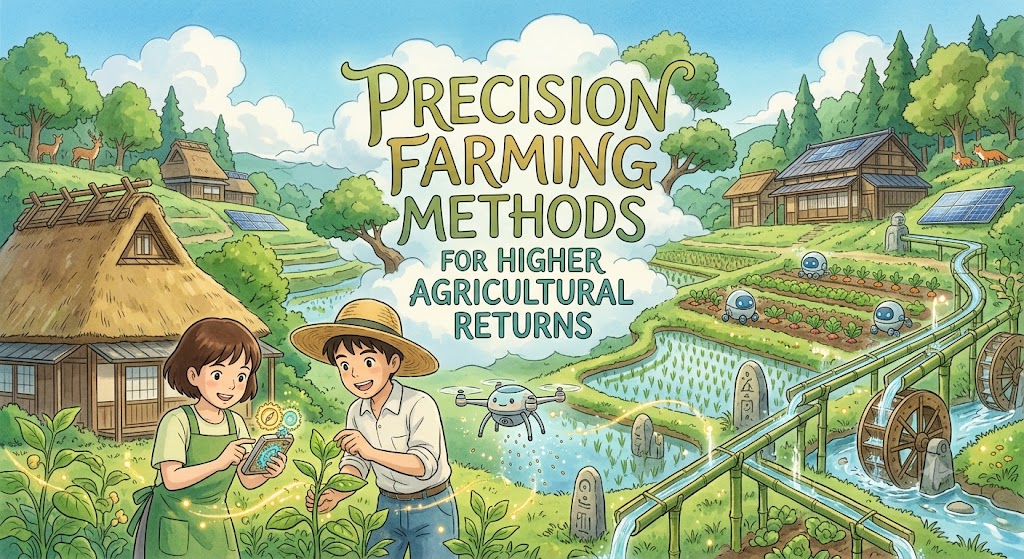
Agriculture is becoming increasingly technology-driven as farmers seek new ways to improve productivity, reduce costs, and maximize profitability. Traditional farming methods often apply the same amount of water, fertilizer, and crop protection products across entire fields, even though growing conditions can vary significantly from one area to another. This can lead to inefficient resource use and lower overall returns.
Precision farming offers a modern solution by using data, technology, and advanced management practices to optimize agricultural production. Rather than treating every part of a field the same, precision farming allows farmers to make site-specific decisions based on actual field conditions. This targeted approach improves efficiency, increases yields, reduces waste, and enhances farm profitability.
As modern agriculture continues to evolve, precision farming is becoming one of the most important tools for achieving higher agricultural returns.
What Is Precision Farming?
Precision farming, also known as precision agriculture, is a management approach that uses technology and data to improve farming decisions.
The goal is to apply the right resource:
- In the right amount
- At the right location
- At the right time
Precision farming relies on information gathered from:
- GPS systems
- Soil sensors
- Drones
- Satellite imagery
- Yield monitors
- Farm management software
These technologies help farmers understand field variability and manage crops more efficiently.
Why Precision Farming Matters
Agricultural fields are rarely uniform.
Variations may exist in:
- Soil fertility
- Moisture levels
- Crop health
- Nutrient availability
- Pest pressure
Applying resources uniformly often results in inefficiencies.
Precision farming helps farmers:
- Increase yields
- Reduce production costs
- Improve resource efficiency
- Enhance sustainability
- Improve profitability
By making data-driven decisions, farmers can achieve better outcomes while minimizing waste.
GPS-Guided Field Operations
Global Positioning System (GPS) technology forms the foundation of many precision farming systems.
GPS guidance helps farmers perform operations with greater accuracy.
Applications include:
- Planting
- Fertilizer application
- Spraying
- Harvesting
Benefits include:
- Reduced overlaps
- Lower input costs
- Improved field efficiency
- Better equipment utilization
Accurate field operations contribute directly to higher agricultural returns.
Soil Testing and Mapping
Understanding soil conditions is essential for effective crop management.
Soil testing helps identify:
- Nutrient levels
- Soil pH
- Organic matter content
- Fertility variations
Soil maps allow farmers to visualize differences across fields and apply nutrients accordingly.
Benefits include:
- Improved fertilizer efficiency
- Reduced nutrient waste
- Better crop performance
Accurate soil information supports more profitable production decisions.
Variable Rate Technology (VRT)
Variable Rate Technology allows farmers to apply inputs according to specific field needs.
Resources that can be managed using VRT include:
- Fertilizers
- Seeds
- Irrigation water
- Crop protection products
Rather than applying a fixed rate across the entire field, farmers can adjust application levels based on field conditions.
Benefits include:
- Reduced input costs
- Improved efficiency
- Higher yields
- Better environmental outcomes
VRT helps maximize returns on every acre of farmland.
Precision Irrigation Management
Water is one of agriculture’s most valuable resources.
Precision irrigation systems use data from:
- Soil moisture sensors
- Weather forecasts
- Crop growth stages
These systems help farmers apply water only when necessary.
Benefits include:
- Improved water efficiency
- Reduced irrigation costs
- Better crop health
- Increased drought resilience
Efficient irrigation contributes to stronger yields and improved profitability.
Remote Sensing Technologies
Remote sensing allows farmers to monitor crop performance using aerial and satellite imagery.
These technologies can identify:
- Nutrient deficiencies
- Water stress
- Pest damage
- Disease outbreaks
- Uneven crop growth
Early detection allows corrective actions before problems significantly affect yields.
Remote sensing improves management efficiency and helps protect crop productivity.
Drone Applications in Precision Agriculture
Agricultural drones have become valuable tools for field monitoring.
Drones can:
- Capture detailed images
- Monitor crop health
- Assess irrigation performance
- Detect field variability
- Support crop scouting activities
Benefits include:
- Faster field inspections
- Improved decision-making
- Reduced labor requirements
- Better crop management
Drone technology helps farmers identify opportunities for improvement throughout the growing season.
Yield Monitoring and Analysis
Modern harvesting equipment often includes yield monitoring systems.
Yield monitors collect information about:
- Crop performance
- Production variability
- Field productivity zones
Yield maps help farmers understand:
- Which areas perform well
- Which areas require improvement
This information supports future decisions regarding:
- Fertility management
- Crop selection
- Irrigation planning
Yield analysis helps farmers continuously improve field performance.
Precision Nutrient Management
Nutrient management is one of the most important factors influencing profitability.
Precision nutrient management involves:
- Soil testing
- Nutrient mapping
- Variable-rate applications
- Crop monitoring
Benefits include:
- Improved fertilizer efficiency
- Reduced costs
- Higher yields
- Better environmental protection
Applying nutrients based on actual crop requirements improves both productivity and profitability.
Integrated Pest Management with Precision Tools
Precision technologies can improve pest and disease management.
Monitoring systems help identify:
- Pest populations
- Disease hotspots
- Crop stress areas
This allows targeted treatment rather than blanket applications.
Benefits include:
- Reduced pesticide use
- Lower costs
- Improved environmental sustainability
- Better crop protection
Targeted management improves efficiency while maintaining crop health.
Farm Management Software
Digital farm management platforms help organize and analyze agricultural data.
Farm software can track:
- Planting schedules
- Fertilizer applications
- Irrigation activities
- Yield records
- Equipment performance
Centralized information improves planning and decision-making.
Accurate records support more profitable farm management strategies.
Internet of Things (IoT) in Agriculture
The Internet of Things connects sensors and devices throughout the farm.
IoT technologies can monitor:
- Soil moisture
- Temperature
- Humidity
- Equipment performance
- Storage conditions
Real-time data allows farmers to respond quickly to changing conditions.
Improved monitoring contributes to higher productivity and efficiency.
Artificial Intelligence and Predictive Analytics
Artificial Intelligence is becoming increasingly important in precision agriculture.
AI systems can:
- Predict yields
- Forecast disease outbreaks
- Analyze weather impacts
- Recommend management actions
Predictive analytics helps farmers anticipate challenges and optimize production strategies.
These technologies improve decision-making and reduce uncertainty.
Economic Benefits of Precision Farming
Farmers adopting precision farming often experience:
- Higher crop yields
- Reduced input costs
- Improved resource efficiency
- Better decision-making
- Increased profitability
Although some technologies require initial investment, many farmers achieve strong returns through improved productivity and cost savings.
Precision agriculture supports both economic and environmental goals.
Building a Precision Farming Strategy
Successful implementation often involves:
- Soil testing and mapping
- GPS-guided equipment
- Yield monitoring systems
- Remote sensing technologies
- Precision irrigation management
- Variable-rate applications
- Data analysis and record keeping
Gradual adoption allows farmers to gain experience while maximizing benefits.
Future Trends in Precision Agriculture
Emerging developments include:
- Fully autonomous machinery
- Advanced AI systems
- Smart robotics
- Enhanced drone capabilities
- Real-time field monitoring networks
These innovations will continue improving agricultural efficiency and profitability.
Conclusion
Precision farming is transforming modern agriculture by enabling farmers to make informed, data-driven decisions that improve productivity and maximize returns. Through technologies such as GPS guidance, variable-rate applications, soil mapping, drones, remote sensing, and artificial intelligence, farmers can optimize resource use while increasing yields and reducing costs.
As agricultural challenges continue to evolve, precision farming will play an increasingly important role in ensuring profitable and sustainable food production. Farmers who embrace precision agriculture today are positioning themselves for stronger financial performance, improved efficiency, and long-term success in the competitive agricultural industry.